inboard electric motors market projected to reach USD 13.1 billion by 2035
The global inboard electric motors market was valued at USD 7.8 billion in 2025 and is projected to reach USD 13.1 billion by 2035, registering a CAGR of 5.3%
 globemarketresearch
Share this Post to earn Money ( Upto ₹100 per 1000 Views )
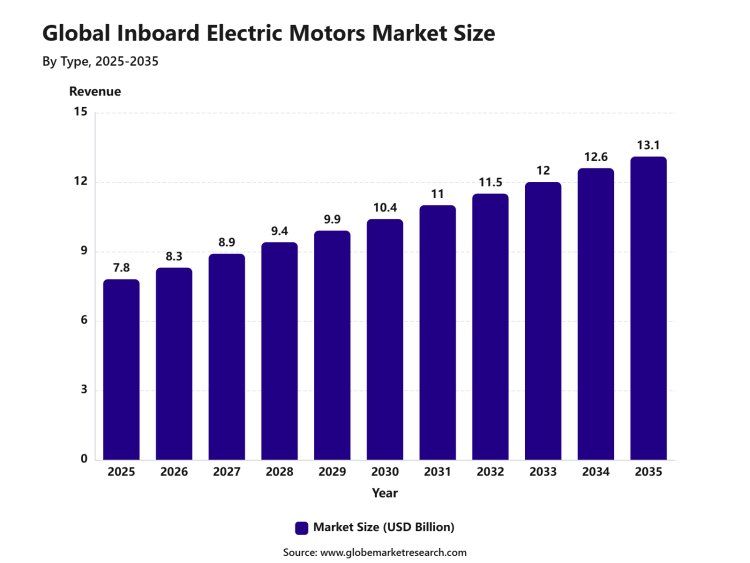
The global inboard electric motors market was valued at USD 7.8 billion in 2025 and is projected to reach USD 13.1 billion by 2035, registering a CAGR of 5.3% from 2025 to 2035. The growth of the market can be attributed to the rising demand for low-emission marine propulsion systems, increasing adoption of electric boats, and stricter regulations aimed at reducing emissions from fuel-based marine engines.
Inboard electric motors are gaining strong traction across recreational boats, commercial vessels, ferries, and small marine transport applications due to their quiet operation, lower maintenance requirements, and improved energy efficiency. The shift toward cleaner propulsion technologies is also being supported by battery advancements, marina electrification, and growing investment in sustainable boating infrastructure. As marine operators focus on reducing operating costs and meeting environmental standards, the adoption of inboard electric motors is expected to increase steadily during the forecast period.
Key Market Insights
-
Low power inboard electric motors below 10 HP led the market with 50.6% share, supported by strong use in small boats, recreational vessels, and low-speed marine applications.
-
Civil entertainment accounted for 45.3% share by application, driven by rising demand for electric boating in leisure, tourism, and personal watercraft activities.
-
Recreational boats held around 57.3% share by boat type, supported by growing consumer preference for quiet, low-emission, and easy-to-maintain marine propulsion systems.
-
Lithium-ion batteries represented around 56.0% share by battery type, driven by higher energy density, longer battery life, faster charging, and better performance compared with traditional battery options.
-
OEM sales channels accounted for around 62.3% share, supported by increasing integration of electric propulsion systems in newly manufactured boats and vessels.
-
Individual boat owners held an estimated 45.5% share by end user, driven by rising interest in sustainable boating, lower operating costs, and improved user experience.
-
Asia Pacific captured 40.7% share of the inboard electric motors market, supported by growing marine tourism, rising boat production, and increasing adoption of electric mobility across coastal economies.
Top Driving Factors
The growth of the inboard electric motors market is mainly driven by the need to reduce emissions from marine transport and recreational boating. Governments, port authorities, and marine operators are placing greater focus on cleaner propulsion systems to reduce fuel use, air pollution, and noise pollution in coastal and inland waterways. Electric propulsion is gaining importance in lakes, rivers, tourist destinations, urban waterways, and protected marine zones where environmental standards are becoming stricter. This shift is creating stable demand for inboard electric motors across both new vessels and retrofit projects.
Another key factor is the improvement in battery performance, motor efficiency, and charging infrastructure. Modern lithium-ion batteries, advanced motor controllers, and high-efficiency permanent magnet motors are making electric boats more practical for daily marine use. Boat owners are also looking for systems that reduce fuel cost, engine servicing, vibration, and onboard noise. These benefits are increasing the appeal of inboard electric motors for recreational boating, passenger ferries, short-distance commercial routes, and premium marine applications.
Demand Analysis
Demand for inboard electric motors is increasing as marine operators move toward cleaner and more cost-efficient propulsion systems. Recreational boating remains an important demand area because electric inboard motors provide smooth operation, reduced noise, and a better onboard experience. Passenger ferries, water taxis, tourism boats, and inland transport vessels are also adopting electric propulsion for short and fixed routes. These routes are suitable for electric systems because vessels can return to charging points after scheduled trips.
Commercial demand is being supported by the need to lower operating costs and meet environmental rules in ports and inland waterways. Fuel-based engines require regular servicing, oil changes, filters, and higher mechanical maintenance, while electric motors have fewer moving parts. This creates long-term cost benefits for operators with high vessel utilization. Demand is also rising from fleet operators that want predictable energy costs, lower downtime, and cleaner brand positioning.
Increasing Adoption Technologies
The adoption of inboard electric motors is increasing due to progress in battery technology, power management systems, and marine-grade electric drivetrains. Lithium-ion batteries are widely used because they offer better energy density, faster charging, and longer operating life compared with older battery systems. Battery management systems are also improving safety by monitoring temperature, voltage, charging cycles, and energy use. These technologies are helping electric boats operate with better reliability and performance.
Digital control systems are also playing an important role in market adoption. Modern inboard electric propulsion systems can be connected with displays, sensors, remote diagnostics, and vessel monitoring platforms. Regenerative power support, smart charging, thermal management, and integrated motor controllers are helping improve energy efficiency. These technologies make electric inboard systems more attractive for boat builders, fleet owners, and operators looking for cleaner and easier vessel management.
Key Reasons for Adoption
The main reason for adopting inboard electric motors is the need for cleaner marine propulsion without reducing vessel usability in short-distance operations. Electric motors produce zero direct emissions during operation, which supports cleaner boating in lakes, rivers, ports, and coastal areas. They also reduce noise and vibration, which improves passenger comfort and protects sensitive marine environments. These advantages are especially important for tourism boats, leisure vessels, ferries, and boats used in protected water zones.
Lower maintenance is another important reason for adoption. Electric motors have fewer mechanical parts compared with internal combustion engines, which reduces wear and service complexity. Operators can benefit from lower fuel handling, fewer oil-related service tasks, and reduced engine downtime. As battery prices improve and charging access expands, the total cost of ownership is expected to become more favorable for many marine use cases.
Investment Opportunities
Investment opportunities in the inboard electric motors market are expected to grow across electric drivetrains, battery packs, charging infrastructure, and vessel retrofit services. Boat manufacturers can benefit by developing electric-ready vessel platforms for recreational boats, ferries, tourism vessels, and inland transport boats. Component suppliers can focus on high-efficiency motors, marine-grade controllers, thermal management systems, and integrated battery solutions. Charging infrastructure providers can also find opportunities in marinas, ports, tourist waterways, and fleet depots.
Retrofit services are expected to become an important opportunity as existing boat owners look to replace aging diesel and gasoline engines. Many vessels used for short trips, tourism, inland transport, and local commercial service can be suitable for electric conversion. Investors can also explore software, diagnostics, fleet energy management, and aftersales service models linked to electric marine propulsion. As regulations tighten and demand for sustainable boating increases, inboard electric motors are expected to remain a practical investment area within the marine electrification ecosystem.