AI Agent Observability Market 2026: Why Monitoring AI Agents Is Becoming Essential for Enterprise AI
AI agents are moving from controlled experiments into real business operations. They are answering customer questions, supporting developers, analyzing data, managing IT workflows, calling external tools, retrieving enterprise information, and increasingly taking actions without step-by-step human direction.
 globemarketresearch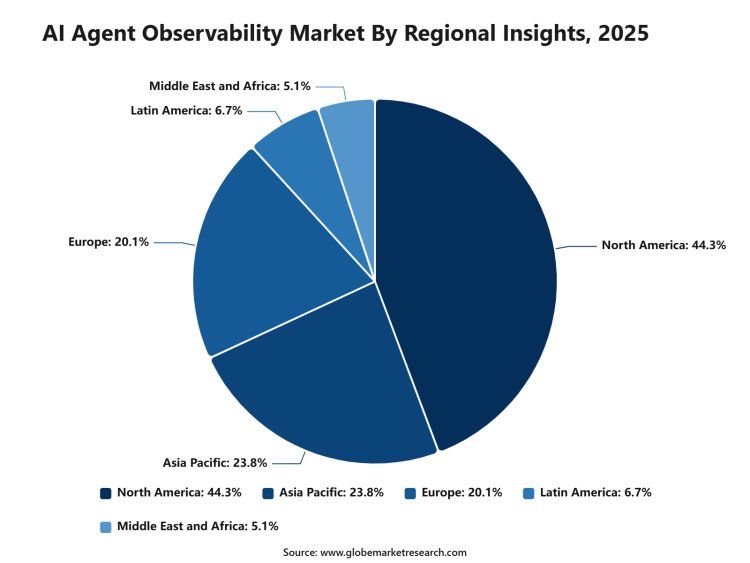
AI agents are moving from controlled experiments into real business operations. They are answering customer questions, supporting developers, analyzing data, managing IT workflows, calling external tools, retrieving enterprise information, and increasingly taking actions without step-by-step human direction.
That shift creates a new operational problem. Traditional application monitoring can show whether a service is running, but it often cannot explain why an AI agent selected a particular tool, repeated an action, produced an incorrect result, consumed excessive tokens, or failed midway through a multi-step workflow.
AI agent observability is being developed to close this visibility gap. Modern platforms combine tracing, evaluation, monitoring, cost analysis, quality measurement, security signals, and governance controls to provide a clearer view of how autonomous AI systems operate in production. OpenTelemetry is also developing standardized GenAI telemetry that can record model calls, token usage, tool invocations, traces, metrics, and events.
AI Agent Observability Market Size
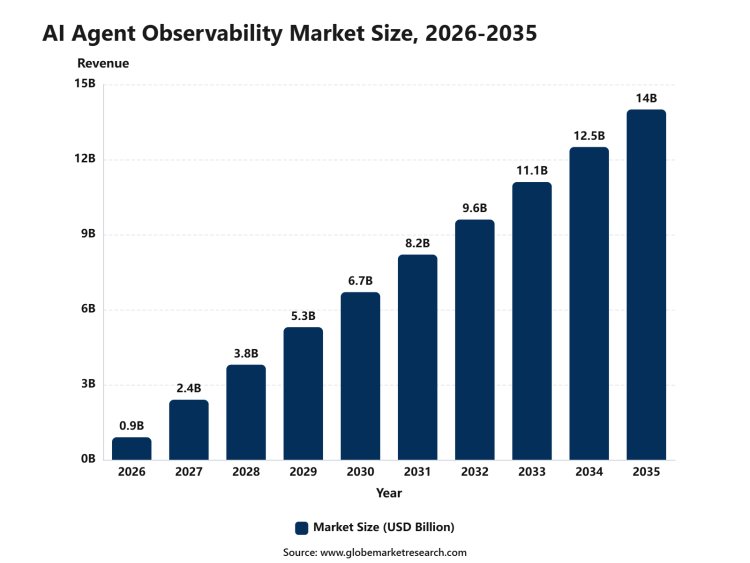
The AI Agent Observability Market is valued at approximately USD 0.9 billion in 2026 and is projected to reach USD 14.0 billion by 2035, expanding at a CAGR of 35.6% from 2026 to 2035. North America accounts for approximately 44.3% of the market in 2026. Growth is being supported by the transition of AI agents from prototypes to production systems, particularly where agents interact with enterprise applications, databases, APIs, external tools, and other agents.
Key growth signals include:
- Production deployment: More companies are moving AI agents beyond proof-of-concept environments.
- Complex workflows: Agents increasingly perform several model calls, retrieval operations, decisions, and tool executions within one task.
- Reliability requirements: Enterprises need to identify hallucinations, failed actions, repeated loops, latency problems, and behavioral drift.
- Cost visibility: Token consumption, model usage, retries, tool calls, and long-running agent loops are becoming measurable operating costs.
- Governance demand: Regulated organizations require stronger records of what agents accessed, decided, and executed.
AI Agent Observability Market Segmentation
The market is developing around the different layers required to understand and control an AI agent throughout its execution lifecycle.
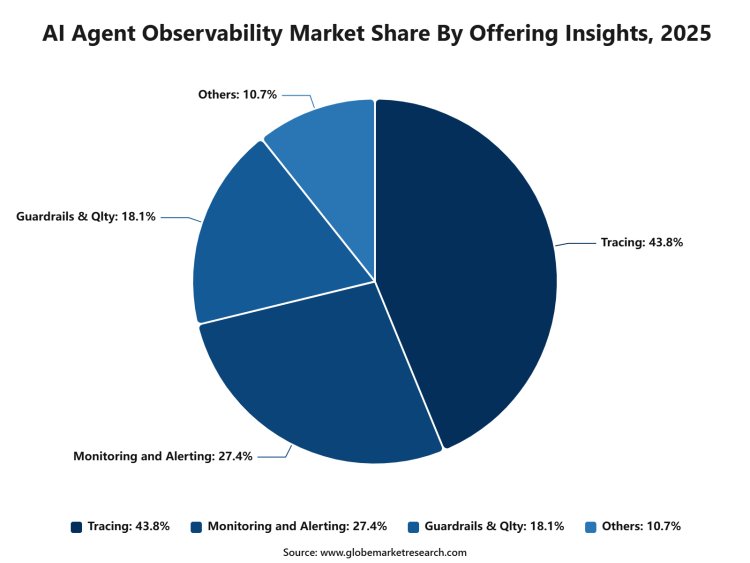
- By offering: Monitoring and alerting, guardrails and quality, tracing and evaluation, and other observability services. Tracing and evaluation represents a leading area, with a 43.8% share.
- By capability: Agent tracing, cost and token monitoring, latency and performance monitoring, and prompt and output evaluation. Agent tracing accounts for approximately 35.6%.
- By model monitored: Proprietary and closed models, open-source models, and fine-tuned or custom models. Proprietary and closed models account for approximately 63.3%.
- By deployment: Cloud, on-premises, and hybrid deployment. Cloud-based platforms hold approximately 69.1%, reflecting the concentration of agent workloads across managed AI and cloud infrastructure.
- By organization and industry: Large enterprises represent approximately 74.6%, while IT and telecommunications accounts for around 30.8% of end-user demand.
AI Agent Observability Market News
Product activity in 2026 shows that agent monitoring is becoming part of mainstream enterprise observability rather than remaining a separate developer tool.
- Dynatrace expanded AI observability: In January 2026, Dynatrace announced general availability of its AI Observability application and added support for agentic frameworks.
- New Relic expanded agent monitoring: In February 2026, New Relic introduced enhanced AI Agent Monitoring capabilities designed to connect agent behavior with application and infrastructure performance.
- Grafana entered real-time AI observability: In April 2026, Grafana Labs introduced AI Observability in Grafana Cloud in public preview for monitoring LLM applications and AI agents, including traces, tool calls, token usage, costs, and evaluations.
- OpenTelemetry strengthened GenAI standards: In May 2026, OpenTelemetry highlighted semantic conventions that standardize telemetry for models, tokens, prompts, responses, and tool interactions.
- Datadog expanded behavioral analysis: In June 2026, Datadog introduced Patterns in Agent Observability to help teams identify recurring production behaviors and investigate agent-quality problems.
Read the detailed AI Agent Observability Market analysis:
https://www.globemarketresearch.com/reports/ai-agent-observability-market
AI Agent Observability Market Trends
1. End-to-End Agent Tracing
Monitoring is moving beyond individual LLM calls toward the complete execution path.
- Model calls are being connected with retrieval operations and tool execution.
- Agent handoffs can be followed across multi-agent workflows.
- Failed steps can be linked back to specific components.
- Latency can be separated across models, APIs, databases, and tools.
- Engineering teams can reconstruct how an agent arrived at an outcome.
Among organizations already running agents in production, 71.5% report having full tracing capabilities, showing how important trace-level visibility becomes after deployment.
2. Continuous Evaluation
Evaluation is increasingly becoming part of production monitoring rather than remaining limited to pre-deployment testing.
- Response quality can be evaluated continuously.
- Task-completion rates can be monitored.
- Hallucinations and policy violations can be detected.
- Model or prompt changes can be compared.
- Human review can be combined with automated evaluation.
Around 52.4% of organizations use offline evaluations, while 37.3% use online evaluations. Among organizations with agents already in production, online evaluation adoption rises to 44.8%.
3. Cost and Token Observability
Agent costs are becoming more difficult to understand because one user request may initiate several model calls and tool actions.
- Token usage is being measured by task and agent.
- Cost can be attributed across models.
- Repeated agent loops can be identified.
- Expensive prompts can be optimized.
- Model-routing decisions can be evaluated against cost and performance.
Datadog's 2026 production telemetry analysis found that average request token usage had more than doubled for median customers year over year, highlighting the growing importance of context and token monitoring.
4. OpenTelemetry-Based AI Monitoring
Open standards are becoming increasingly important as companies use multiple AI providers, agent frameworks, cloud platforms, and observability systems.
- Telemetry can be moved between compatible platforms.
- Model and infrastructure traces can be correlated.
- Tool executions can be included within agent traces.
- Vendor dependence can be reduced.
- Existing enterprise observability infrastructure can be extended to AI.
OpenTelemetry's GenAI conventions include standardized information about model calls, token counts, tool calls, and other AI operations.
5. Observability as an AI Control Layer
Observability is beginning to support decisions rather than simply record activity.
- Abnormal agent behavior can trigger alerts.
- Quality degradation can initiate investigation workflows.
- Policy violations can be surfaced immediately.
- Agent performance can be compared with business outcomes.
- Automated root-cause analysis can shorten incident resolution.
Dynatrace's 2026 research found that approximately 69% of organizations use observability during agentic AI implementation, with observability also being used during development and operational deployment.
AI Agent Observability Market Statistics
Several 2026 indicators show how quickly agent monitoring is becoming part of production AI engineering.
- 57.3% of surveyed organizations have AI agents running in production, while another 30.4% are actively developing agents with plans to deploy them.
- 89% of organizations have implemented some form of agent observability, while 62% use detailed tracing for individual steps and tool calls.
- Among organizations with production agents, 94% have observability in place and 71.5% have full tracing capabilities.
- 51% of senior enterprise leaders identified technical challenges related to managing and monitoring agents at scale as a barrier to production deployment.
- Datadog found that 5% of LLM call spans recorded an error in February 2026, and 60% of those errors were associated with rate limits, illustrating why infrastructure and model-level visibility must be connected.
AI Agent Observability Market Opportunities
The strongest opportunities are likely to develop where observability moves beyond dashboards into continuous AI operations.
- Real-time agent tracing: Enterprises need immediate visibility into model calls, tools, memory, retrieval, handoffs, and execution paths.
- Multi-agent observability: Multiple agents interacting with each other create additional dependencies and more complex failure patterns.
- Automated root-cause analysis: AI-assisted investigation can reduce the time required to identify whether a failure originated in a model, prompt, API, retrieval layer, or external tool.
- Cost intelligence: Platforms that connect tokens, compute, model selection, agent loops, and task outcomes can help organizations measure the true operating cost of autonomous systems.
- Governance and compliance monitoring: Audit trails, policy enforcement, permission monitoring, and behavioral evidence will become particularly important in BFSI, healthcare, government, and other regulated sectors.
AI Agent Observability Market Challenges
The technology still faces important implementation barriers.
- Agent behavior is non-deterministic: The same input may not always create an identical execution path or result.
- Multi-agent environments are complex: Problems can emerge across models, APIs, tools, databases, memory systems, and other agents.
- Telemetry volumes can become expensive: Continuous collection of traces, prompts, responses, tool calls, metrics, and evaluations creates storage and processing requirements.
- Sensitive information may appear in traces: Prompts, retrieved documents, customer information, and tool outputs may contain confidential data. OpenTelemetry notes that content capture must be deliberately enabled because such information can be sensitive.
- Technical metrics must be connected with business results: Low latency alone does not prove that an agent successfully resolved a customer issue, completed a workflow, or produced an accurate decision.
AI Agent Observability Market by Region
North America
North America accounts for approximately 44.3% of the global market, supported by strong enterprise AI adoption, cloud infrastructure, software development activity, and early deployment of autonomous AI workflows.
- Strong concentration of AI platform developers.
- Early enterprise adoption of agentic applications.
- Large cloud and data-center infrastructure base.
- High observability software adoption.
- Increasing demand for AI security and governance.
Europe
Europe represents an important opportunity as enterprises balance automation with regulatory, governance, privacy, and accountability requirements.
- Strong demand from financial services.
- Increasing enterprise AI governance requirements.
- Growing interest in traceability and auditability.
- Hybrid and sovereign infrastructure needs.
- Strong opportunity for privacy-aware observability systems.
Asia Pacific
Asia Pacific is expected to benefit from expanding cloud infrastructure and enterprise AI adoption across technology, telecom, banking, manufacturing, and digital services.
- Rapid growth of enterprise AI deployments.
- Large telecommunications ecosystem.
- Strong cloud infrastructure investment.
- Growing adoption of automated customer operations.
- Opportunity for localized and multi-model monitoring.
Latin America
Adoption is developing alongside cloud migration and the expansion of AI-powered business services.
- Increasing use of cloud-based AI.
- Demand for affordable managed observability.
- Growth in digital banking and e-commerce.
- Customer-service automation opportunities.
- Potential for SaaS-based monitoring platforms.
Middle East and Africa
AI infrastructure investment and government digital programs are creating longer-term opportunities.
- Expansion of sovereign AI projects.
- Growing enterprise automation.
- Smart-government initiatives.
- Banking and telecom AI adoption.
- Demand for scalable cloud observability.
The market's formal regional coverage includes North America, Europe, Asia Pacific, Latin America, and the Middle East and Africa.
AI Agent Observability Market by Industry
IT and Telecommunications
IT and telecommunications represents the leading end-user segment at approximately 30.8%.
- Network operations
- Software development agents
- IT service management
- Cybersecurity automation
- Customer-service agents
BFSI
Financial institutions require particularly strong visibility because autonomous agents may interact with transactions, customer information, risk systems, and regulated processes.
- Fraud investigation
- Customer support
- Financial analysis
- Compliance workflows
- Internal operations
Healthcare
Healthcare applications increase the need for reliability, data controls, traceability, and human oversight.
- Clinical workflow support
- Patient-service agents
- Documentation
- Administrative automation
- Healthcare information retrieval
Retail and E-commerce
Customer-facing agents make response quality and task completion directly measurable against business results.
- Shopping assistance
- Product recommendations
- Customer service
- Order management
- Personalized engagement
Manufacturing
Industrial organizations are exploring agents across operations, engineering, maintenance, supply chains, and enterprise systems.
- Maintenance support
- Production analysis
- Supply-chain workflows
- Engineering assistance
- Operational troubleshooting
AI Agent Observability Market Company Profiles
Datadog
Datadog is extending traditional application observability into AI Agent Observability.
- Agent tracing
- LLM experimentation
- Production monitoring
- Token and latency analysis
- Agent quality evaluation
Its Agent Observability offering combines experimentation with production-level tracing and evaluation.
Dynatrace
Dynatrace is positioning AI observability within its wider enterprise monitoring environment.
- AI agent monitoring
- Model observability
- OpenTelemetry integration
- Infrastructure correlation
- Agentic framework support
Its AI Observability application became generally available in January 2026.
New Relic
New Relic is connecting agent monitoring with traditional application performance management.
- Agent behavior monitoring
- Infrastructure correlation
- Workflow analysis
- Operational automation
- Incident investigation
Its 2026 updates position agent monitoring within a broader full-stack observability environment.
LangChain through LangSmith
LangSmith provides observability capabilities for LLM applications and agents across multiple frameworks and model providers.
- Distributed tracing
- Agent debugging
- Evaluation
- Production metrics
- Framework-independent integrations
LangSmith supports integrations across OpenAI, Anthropic, CrewAI, Vercel AI SDK, Pydantic AI, and other technology environments.
Arize AI
Arize's Phoenix platform focuses on open-source AI observability and evaluation.
- Agent tracing
- Evaluations
- Failure investigation
- OpenTelemetry support
- Multi-framework integrations
Phoenix supports tools and frameworks including OpenAI, Anthropic, LangGraph, LangChain, CrewAI, and LlamaIndex.
What Are the Future Opportunities in the AI Agent Observability Market?
The next phase of the market is likely to be defined by platforms that can move from seeing what agents did to helping enterprises understand, control, and improve what agents will do next.
- Autonomous observability agents: Monitoring platforms can increasingly use AI agents themselves to investigate failures, correlate telemetry, and recommend corrective actions.
- Multi-agent dependency maps: Enterprises will require visual and machine-readable maps showing how agents, models, tools, APIs, databases, and workflows depend on each other.
- Business-outcome observability: Monitoring will expand from latency and tokens toward task success, revenue impact, customer resolution, conversion, risk, and productivity.
- Security plus observability convergence: Agent identity, permissions, tool access, prompt attacks, data exposure, and abnormal actions can increasingly be analyzed alongside reliability signals.
- AI reliability platforms: Tracing, evaluation, governance, security, cost management, and performance optimization could increasingly converge within a common enterprise control layer.
This opportunity becomes more important as architectures become distributed. Datadog's 2026 analysis found that only 18% of observed end-to-end agentic requests made three or more service calls, suggesting that many production agents are still relatively monolithic. As systems become more distributed and multi-agent architectures expand, cross-service tracing and dependency monitoring should become considerably more important.
AI Agent Observability Market FAQs
What is AI agent observability?
AI agent observability is the process of monitoring and analyzing how an AI agent performs a task across model calls, reasoning workflows, retrieval systems, tools, APIs, memory, and other agents. It helps teams understand what happened during an execution and identify where failures, delays, excessive costs, or unexpected behavior occurred.
Why do AI agents require different observability tools?
AI agents are more dynamic than traditional applications. A single task can involve multiple models, changing execution paths, external tools, retrieval operations, retries, and autonomous decisions, making conventional logs and infrastructure metrics insufficient on their own.
What are the most important AI agent observability metrics?
Important measures include task-success rate, response quality, model and tool latency, errors, token consumption, cost, tool-call success, retrieval quality, safety violations, agent-loop length, and evaluation scores.
What technologies are shaping the AI Agent Observability Market?
The market is being shaped by distributed tracing, OpenTelemetry, LLM evaluations, automated root-cause analysis, semantic telemetry, AI guardrails, prompt monitoring, cost analytics, and multi-agent tracing. OpenTelemetry's standardization work is particularly important for interoperability across different AI stacks.
What is the growth outlook for AI agent observability?
Growth prospects remain strong as enterprises move more agents into production. The market is projected to increase from USD 0.9 billion in 2026 to USD 14.0 billion by 2035, with reliability, security, governance, cost management, and production-scale agent deployment acting as major demand drivers.
Final Perspective
AI agent observability is moving rapidly from a developer debugging feature to an enterprise requirement for reliable autonomous AI.
The direction of the technology is becoming clear. Enterprises do not only need to know whether an agent is online. They need visibility into what the agent did, which information it used, which tools it called, what the action cost, whether the result was correct, and whether the action stayed within defined business and security policies.
As more agents gain access to enterprise systems and are allowed to complete increasingly complex workflows, observability will become an important bridge between AI autonomy and enterprise control.
For buyers, the priority should therefore move beyond basic logging. Platforms should be assessed for end-to-end tracing, live evaluations, interoperability, cost attribution, security integration, multi-agent visibility, and the ability to connect technical agent behavior with measurable business outcomes.
You Might Also Find This Useful:
https://www.globemarketresearch.com/reports/ai-observability-tools-market
https://www.globemarketresearch.com/reports/ai-agent-identity-management-market
https://www.globemarketresearch.com/reports/agentic-ai-security-market
https://www.globemarketresearch.com/reports/ai-data-centre-cooling-market
https://www.globemarketresearch.com/reports/shooting-games-market
https://www.globemarketresearch.com/reports/micro-investing-app-market
https://www.globemarketresearch.com/reports/us-ai-agent-identity-management-market
https://www.globemarketresearch.com/reports/chiplet-market
https://www.globemarketresearch.com/reports/chiplet-testing-market
https://www.globemarketresearch.com/reports/workload-identity-management-market
https://www.globemarketresearch.com/reports/identity-threat-detection-and-response-itdr-market
https://www.globemarketresearch.com/reports/physical-ai-in-automotive-market
https://www.globemarketresearch.com/reports/ai-security-posture-management-market
https://www.globemarketresearch.com/reports/restaurant-ai-receptionist-market
https://www.globemarketresearch.com/reports/ai-model-router-market
https://www.globemarketresearch.com/reports/ai-receptionist-payment-collection-market
https://www.globemarketresearch.com/reports/reusable-digital-identity-market
https://www.globemarketresearch.com/reports/deepfake-ai-market
https://www.globemarketresearch.com/reports/ai-application-security-platform-market
https://www.globemarketresearch.com/reports/ai-workflow-orchestration-market
https://www.globemarketresearch.com/reports/germany-ai-orchestration-market-2025-2030
https://www.globemarketresearch.com/reports/germany-ai-agents-market-market
https://www.globemarketresearch.com/reports/agentic-ai-in-healthcare-market
https://www.globemarketresearch.com/reports/europe-creator-economy-market
https://www.globemarketresearch.com/reports/japan-physical-ai-market
https://www.globemarketresearch.com/reports/ai-server-power-semiconductor-market
https://www.globemarketresearch.com/reports/custom-ai-asic-market
Suggested LinkedIn hashtags:
#AIAgents #AgenticAI #AIObservability #AIAgentObservability #EnterpriseAI #LLMOps #AIOps #ArtificialIntelligence #OpenTelemetry #GenerativeAI #AIInfrastructure #AIGovernance