Italy Agentic AI Market: Why Autonomous AI Is Becoming an Enterprise Priority?
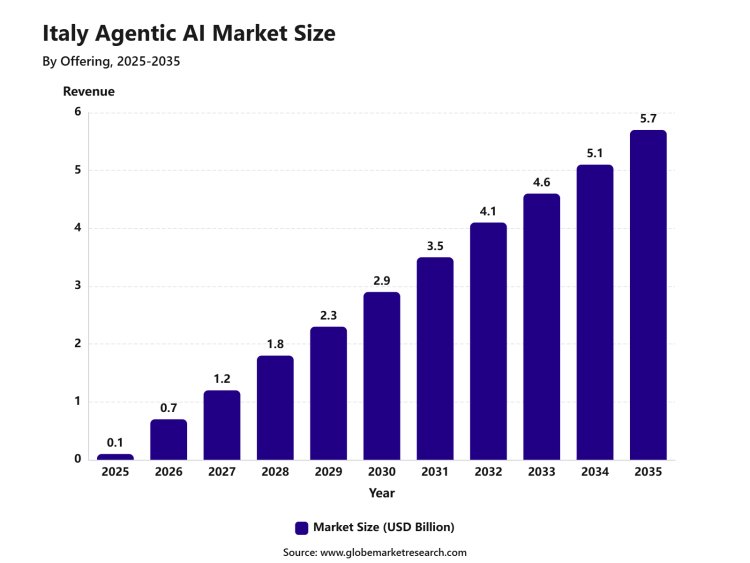
The Italy Agentic AI Market was valued at USD 0.1 billion in 2025 and is projected to reach USD 5.7 billion by 2035, growing at a CAGR of 49.9% during the forecast period.
 globemarketresearch
Share this Post to earn Money ( Upto ₹100 per 1000 Views )
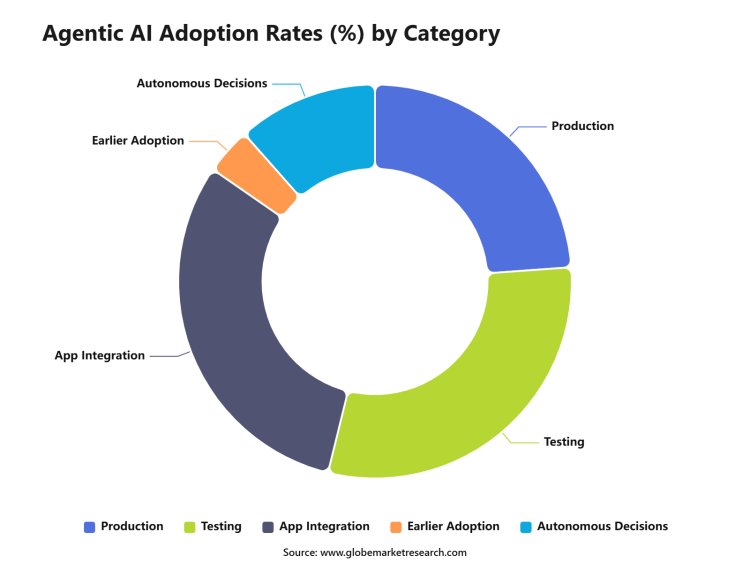
Agentic AI is becoming one of the most important technology shifts for Italian enterprises. Unlike basic chatbots, agentic AI systems can plan tasks, take actions, connect with business software, support decisions, and complete workflows with limited human input. This makes the technology highly relevant for banking, insurance, manufacturing, telecom, retail, healthcare, and public services.
The Italy Agentic AI Market was valued at USD 0.1 billion in 2025 and is projected to reach USD 5.7 billion by 2035, growing at a CAGR of 49.9% from 2025 to 2035. Demand is being supported by rising enterprise automation needs, wider cloud adoption, and growing use of generative AI and LLM-based agents across business functions.
Why Italy Is Becoming Important for Agentic AI
Italy is still at an early stage of AI adoption, but the market base is improving quickly. Italian firms using AI doubled to 16.4% in 2025, compared with 8.2% in 2024 and 5.0% in 2023. Large companies are moving faster, with 53.1% of firms with more than 250 employees using AI, compared with 15.7% among smaller firms.
This gap shows a clear opportunity. Large enterprises are expected to lead early adoption because they have stronger technology budgets, better data systems, and more structured governance. SMEs may follow as agentic AI tools become easier to deploy, more affordable, and better connected with cloud platforms.
Key Market Insights
- Solutions led the offering segment with 69.3% share in 2025. Growth was supported by rising demand for ready-to-deploy AI platforms, automation tools, conversational agents, and intelligent workflow systems.
- Cloud-based deployment accounted for 68.6% share. The segment benefited from faster implementation, lower infrastructure needs, scalable access, and easier integration with enterprise software systems.
- Multi-agent systems held 56.1% share by agent system. These systems are gaining attention because they can coordinate complex tasks across customer service, compliance, finance, document processing, and operations.
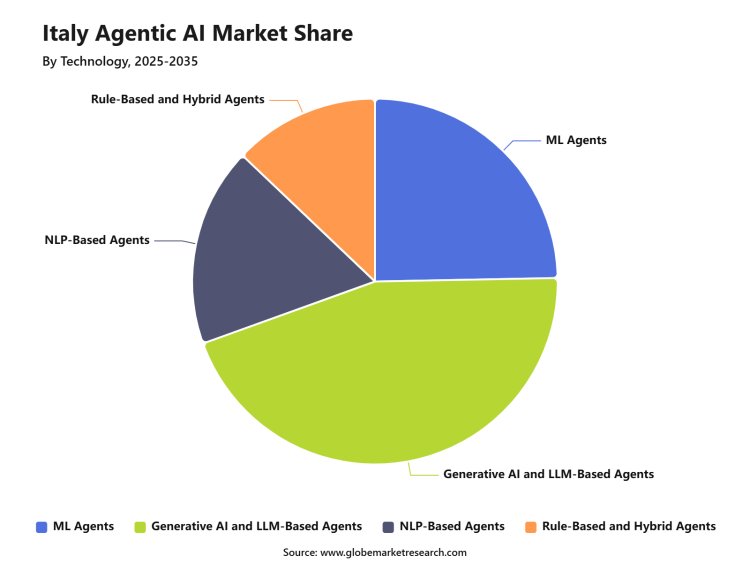
- Generative AI and LLM-based agents led the technology segment with 44.8% share. Their adoption is being driven by use cases such as content generation, coding support, document summarization, customer support, and internal productivity.
- Operations and process automation accounted for 27.1% share by function. Demand was driven by workflow optimization, decision support, faster response times, and the need to reduce repetitive manual work.
- Large enterprises dominated by enterprise size with 71.1% share, while BFSI led the end-use segment with 35.8% share. BFSI adoption is being supported by fraud detection, risk assessment, claims handling, regulatory reporting, and customer service automation.
Enterprise Adoption Is Rising, But Barriers Remain
The broader European market is also moving toward AI adoption. In 2025, 19.95% of EU enterprises used AI technologies, while 55.03% of large EU enterprises used AI. This supports the view that large organizations will remain the strongest early adopters of agentic AI in Italy and across Europe.
However, adoption is not without challenges. Italian firms still face barriers such as lack of AI skills, regulatory uncertainty, data protection concerns, and high implementation costs. Reuters reported that lack of skills was cited by 58.6% of non-adopting firms, followed by unclear regulations at 47.3%, data protection concerns at 43.2%, and high costs at 43.0%.
Where Agentic AI Can Create Value
The strongest near-term use cases are expected in customer support, document processing, compliance workflows, risk monitoring, sales assistance, IT operations, and internal productivity. These areas involve repeated tasks, large information flows, and rules-based decisions, which makes them suitable for AI agent deployment.
Microsoft Italy reported that only 2.3% of Italian companies were using agentic AI technologies, compared with the 4.2% European average. However, companies using generative AI reported clear business benefits, including efficiency and productivity gains at 64%, customer support benefits at 39%, and process optimization benefits at 36%.
This suggests that agentic AI is still early in Italy, but the business case is becoming stronger. As companies gain confidence in generative AI, the next step will likely be autonomous agents that can support workflows, execute tasks, and improve decision speed.
BFSI and Manufacturing Are Strong Opportunity Areas
BFSI is expected to remain one of the strongest sectors for agentic AI in Italy. Banks, insurers, and financial service providers can use AI agents for fraud checks, customer onboarding, claims review, loan assessment support, compliance monitoring, and internal reporting.
Manufacturing is another promising area. Italy has a strong industrial base, and agentic AI can support predictive maintenance, supply chain coordination, production planning, quality checks, and procurement workflows. As manufacturers modernize operations, demand for AI systems that can improve efficiency and reduce manual intervention is expected to increase.
Competitive Landscape
The Italy Agentic AI Market is becoming competitive as global technology companies, cloud providers, enterprise software vendors, and AI startups expand their agent-based offerings. Companies are focusing on workflow automation, secure integrations, LLM-based agents, AI governance, and industry-specific solutions.
Key companies profiled in the market include OpenAI, Google, Microsoft, IBM, Amazon, Anthropic, Cohere, AI21 Labs, Hugging Face, Salesforce, Oracle, SAP, NVIDIA, Meta, and Databricks.
Conclusion
Italy’s agentic AI market is still in an early phase, but the growth outlook is strong. Rising AI adoption, enterprise automation needs, cloud-based platforms, and demand for better productivity are expected to support long-term expansion.
The main opportunity will be seen in practical, secure, and well-governed AI agents that solve real business problems. Companies that focus on measurable outcomes, human oversight, data protection, and smooth integration with existing systems are expected to gain the strongest advantage.
Sources:
https://vocal.media/futurism/italy-agentic-ai-market-to-exceed-usd-5-7-bn-by-2035