GainzAlgo V2 Risk Management: Customizing Stop Loss and Drawdown Settings
Customize stop loss, take profit and drawdown settings in GainzAlgo V2. Get practical risk rules, ATR stop levels and position sizing that work.
 gainzalgo
Share this Post to earn Money ( Upto ₹100 per 1000 Views )
I have spent more than twenty years writing about markets and stress-testing trading tools. One lesson repeats itself. Most traders do not fail because their signals are bad. They fail because their risk settings are wrong.
A signal tool tells you where to enter. Your risk settings decide whether you last long enough to profit from those entries. That is where the real edge lives.
This guide walks through risk management in GainzAlgo V2. You will learn how to shape your stop loss, cap your drawdown, and size trades on purpose. No jargon. No filler. Just the settings that move the needle.
Why Risk Settings Beat Signal Quality
Try a quick thought experiment.
Two traders take the same fifty signals. Both win 60% of the time. Trader A risks 1% per trade. Trader B risks 8%.
After one rough week of four losses, Trader A is down about 4%. Trader B is down more than 25% and rattled. Fear then changes behavior. Trader B skips the next setup, and that one wins.
Same tool. Same signals. Two very different accounts.
The gap did not come from the chart. It came from the settings panel. This is why traders who use GainzAlgo V2 seriously spend more time on risk inputs than on signal hunting.
How GainzAlgo V2 Handles Exits
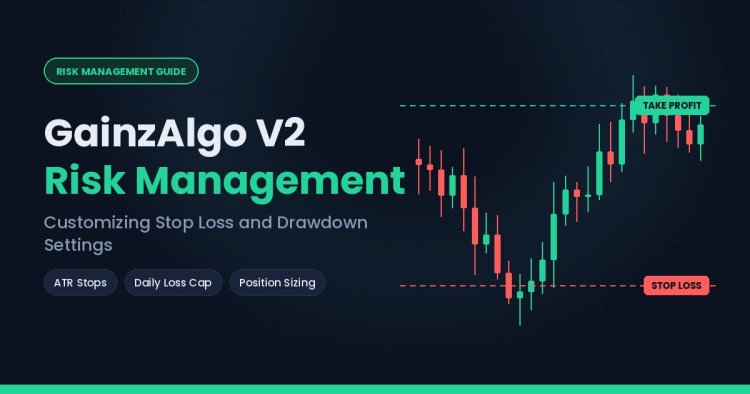
GainzAlgo V2 is an AI trading indicator built to read price action and print clean entry signals. It also works as a take profit and stop loss indicator. That means it plots your exit levels, not just your entry arrow.
That second job matters. Plenty of tools show an arrow and stop there. You are left guessing where the stop belongs. Guessing is not a plan.
When your stop and target appear on the chart at signal time, three good things happen:
- You know your risk before you click buy.
- You can size the position correctly.
- You remove the urge to move your stop mid-trade.
The GainzAlgo V2 Alpha indicator follows the same logic with a more selective signal filter. Fewer signals. Tighter conditions. Same need for disciplined exits.
Customizing Your Stop Loss
There is no single correct stop. There is only a stop that fits your market, your timeframe, and your nerves. Here are the three approaches I recommend testing.
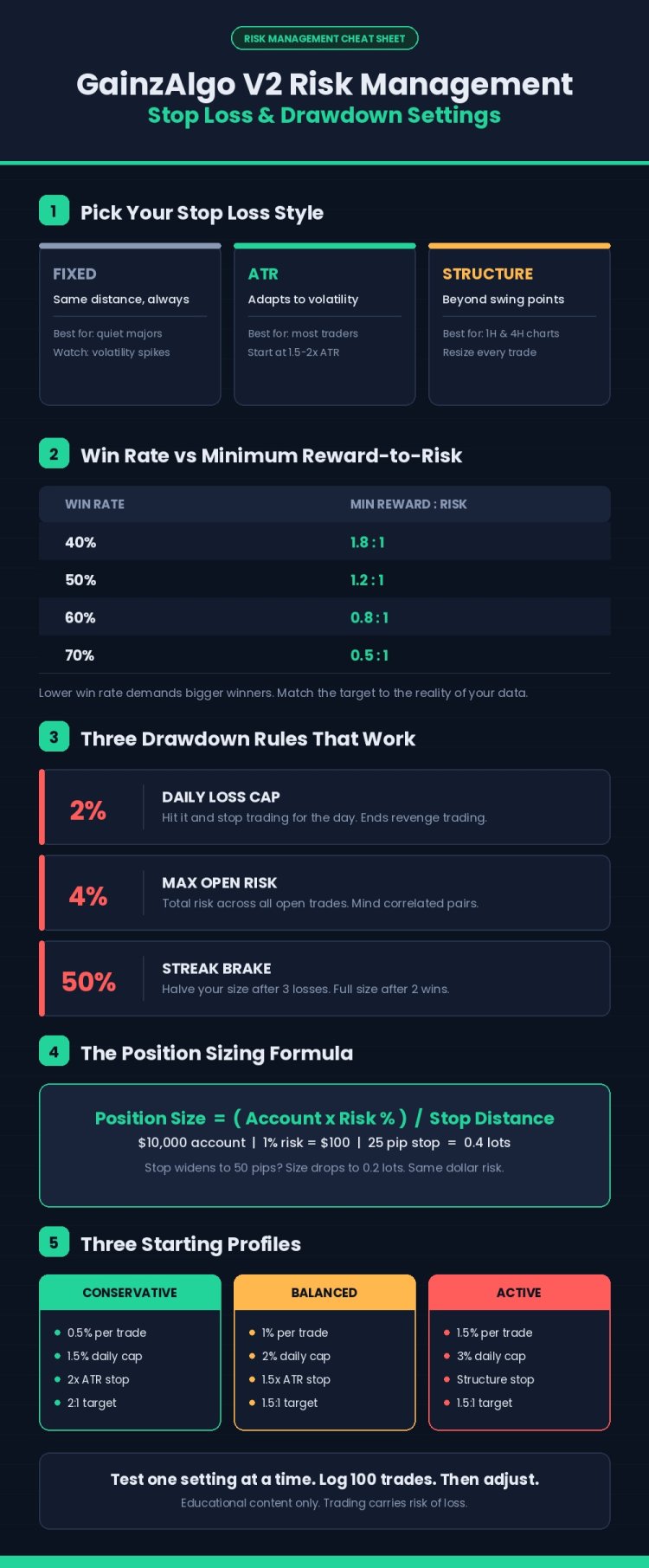
1. Fixed Distance Stops
You set a fixed number of pips, points, or ticks. Simple and predictable.
This suits low-volatility pairs and traders who want the same risk on every trade. It struggles when volatility spikes, because a fixed stop can sit too close to normal noise.
Use it on majors like EUR/USD during quiet sessions. Avoid it around news releases.
One tip from experience. If you run a fixed stop in GainzAlgo V2, check the average candle range on your timeframe first. Your stop should sit outside a normal candle. Inside it, you are paying for noise.
2. Volatility-Based Stops (ATR)
Here your stop widens when the market gets loud and tightens when it calms down. Average True Range drives the distance.
This is my default recommendation for most traders. Markets change character weekly. A stop that adapts survives longer than one that does not.
A practical starting point is 1.5 to 2 times ATR. Below 1.5, you get stopped out on noise. Above 3, your losses grow faster than your wins can repair them.
3. Structure-Based Stops
You place the stop beyond the last swing high or swing low. Price has to actually break structure to take you out.
This gives your trade room to breathe. It also creates uneven risk from trade to trade, so you must adjust position size for every entry.
Structure stops pair well with the GainzAlgo V2 Alpha indicator on higher timeframes, where swing points are cleaner and more meaningful.
Which Stop Should You Choose?
Ask three questions.
How volatile is your market? Loud markets need ATR stops. How much screen time do you have? Fixed stops are easier to manage in a hurry. How wide is your account's tolerance? Structure stops demand flexible sizing.
Most traders land on ATR stops and stay there. It is the setting I would test first in GainzAlgo V2 if you are starting from zero.
Matching Take Profit to Your Stop
Your stop and target are two halves of one decision. Change one and you change the math.
A useful rule of thumb:
| Win rate | Minimum reward-to-risk |
|---|---|
| 40% | 1.8 : 1 |
| 50% | 1.2 : 1 |
| 60% | 0.8 : 1 |
| 70% | 0.5 : 1 |
Read it this way. If your setup wins half the time, you need to make at least 1.2 times what you risk to grow the account after costs.
Many traders set a 3:1 target and wonder why they lose. The target was never the problem. Price simply never reached it. A target you never hit is not a target. It is a wish.
Start at 1.5:1. Log the results. Adjust from evidence, not hope.
Drawdown Settings: Your Second Line of Defense
Stop losses protect single trades. Drawdown rules protect your account and your mindset. You need both.
Three rules do most of the work.
Daily Loss Cap
Pick a number. When you hit it, you stop for the day. Two percent works well for most retail accounts.
This is the single most valuable rule I have ever seen a trader adopt. It ends revenge trading before it starts. One bad morning stays a bad morning instead of becoming a bad month.
Make it physical. Write the dollar figure on a sticky note beside your screen. When the number is hit, close the platform. Do not watch. Watching turns into clicking.
Maximum Open Risk
Cap the total risk you carry at any moment. Four percent across all open positions is a sensible ceiling.
Watch out for correlation. Three long positions in EUR/USD, GBP/USD, and AUD/USD are close to one big dollar-short trade. They will lose together.
Losing Streak Circuit Breaker
After three losses in a row, drop your position size by half. Return to full size only after two wins.
Streaks happen to every strategy. This rule keeps a normal streak from becoming a serious hole.
Position Sizing: The Setting Most Traders Skip
Your stop distance and your position size must move together. If one changes, the other has to change too.
The formula is short:
Position size = (Account × Risk %) ÷ Stop distance
An example. You hold a $10,000 account. You risk 1%, so $100. Your stop sits 25 pips away. On a standard forex pair, that gives you roughly 0.4 lots.
Now suppose volatility rises and your stop moves to 50 pips. Your size must drop to about 0.2 lots. Same dollar risk. Different position.
Traders who ignore this step take random risk on every trade. Their results look random too, and they blame the indicator.
Filters That Quietly Cut Drawdown
Some of your best risk tools are not labeled as risk tools.
- Session filters. Trade only when your market has real liquidity. The London and New York overlap gives forex traders tighter spreads and cleaner follow-through. Late Asian hours produce more false breaks.
- News avoidance. Stand aside for thirty minutes around major releases. Spreads widen, slippage grows, and stops get hit at prices you never agreed to.
- Higher timeframe agreement. Take signals that align with the trend one timeframe up. A single moving average on the higher chart is enough. This one filter removes a large share of low-quality trades.
- Signal spacing. Set a minimum bar gap between entries. It stops you from stacking three trades on the same move.
Layer two of these filters onto GainzAlgo V2 and your signal count drops. That feels like a loss at first. Then you check the equity curve and see a smoother line. Fewer trades with better context beats more trades with none.
Test Before You Trust
I have never seen a settings profile work everywhere. Not once in twenty years.
Here is a testing routine that works:
- Change one input at a time. Adjust five at once and you learn nothing.
- Gather at least 100 trades. Thirty trades tell you about luck, not about edge.
- Test across two market types. Include a trending stretch and a choppy stretch.
- Track maximum drawdown, not just profit. A strategy that earns 40% while dropping 30% will break you emotionally.
- Forward test on demo for two weeks. Backtests hide slippage, spread changes, and your own hesitation.
Write your numbers down. A trading journal beats memory every time, because memory edits the story in your favor.
Three Starting Profiles for GainzAlgo V2
Use these as a launch point, then adapt from your own data.
- Conservative. Risk 0.5% per trade. Daily cap 1.5%. Stop at 2× ATR. Target 2:1. Higher timeframe filter on.
- Balanced. Risk 1% per trade. Daily cap 2%. Stop at 1.5× ATR. Target 1.5:1. Session filter on.
- Active. Risk 1.5% per trade. Daily cap 3%. Structure stops. Target 1.5:1. Manual news filter.
Notice something. Even the active profile stays under 2% per trade. Professional risk limits are boring on purpose.
Mistakes I See Again and Again
- Widening a stop mid-trade. You are not saving the trade. You are cancelling the plan.
- Copying settings from a screenshot. Their account size, broker, and schedule are not yours.
- Ignoring spread and commission. On a 15-pip target, a 2-pip spread eats 13% of your reward.
- Trading full size after a break. Return at half size for a week and rebuild rhythm first.
- Judging a week. Ten trades prove nothing. Judge in blocks of a hundred.
Frequently Asked Questions
Should beginners use tight or wide stops? Start moderate at 1.5 to 2× ATR, and keep risk small. Tight stops feel safe but get hit constantly.
Do I still need a hard stop with the indicator plotting one? Yes. Always place a live stop order with your broker. Charts do not stop losses. Orders do.
How often should I change my settings? Review monthly. Change only when 100 trades of data point somewhere clearly.
Which timeframe works best? Higher timeframes give cleaner signals and calmer decisions. The 1-hour and 4-hour charts suit most working traders.
What is the difference between the standard and Alpha versions? The GainzAlgo V2 Alpha indicator applies stricter entry conditions. You get fewer signals with tighter filtering. Your risk settings should still follow the same principles either way.
Can I use one risk profile across every market? No. Gold moves differently from EUR/USD, and crypto moves differently again. Keep a separate saved profile in GainzAlgo V2 for each instrument you trade.
Is a trailing stop better than a fixed target? It depends on the market. Trailing stops capture strong trends but give back profit in ranges. Test both. Let the data decide.
Final Thoughts
Risk management is not the exciting part of trading. It is the part that keeps you in the game long enough for your edge to show up.
Set your stop with intent. Cap your daily loss. Size every position to the risk, not to your mood. Then let the process run.
If you are ready to build these rules into your own chart routine, GainzAlgo gives you the signal clarity and exit levels to do it properly. Start with a conservative profile, keep a journal, and let your own numbers guide the next adjustment. Protect the account first, and the profits get a chance to follow.