
Digital Transformation in Schools with School Information Systems
Discover how School Information Systems (SIS) drive digital transformation in schools by streamlining administration, improving communication, enhancing data management, and supporting better educational outcomes.
 franciscansolutions
Share this Post to earn Money ( Upto ₹100 per 1000 Views )
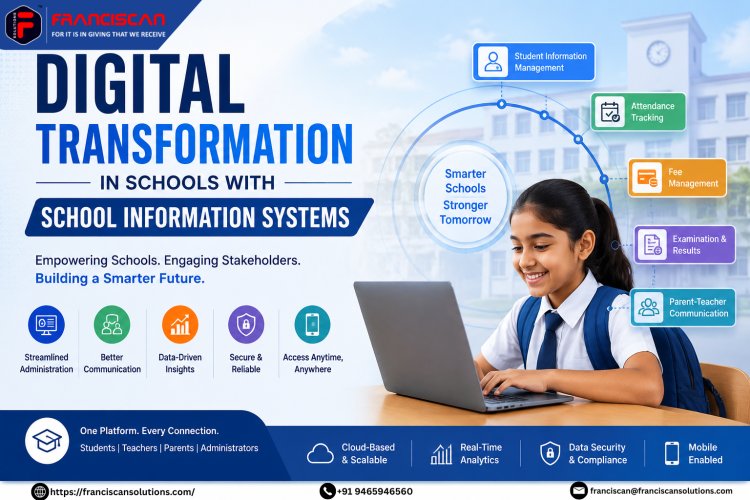
Educational systems are changing dramatically as technology adoption becomes the order of the day in schools aiming at achieving greater efficiency, improved communication, and better learning results. The old-fashioned approach to running administrative processes involving much paperwork is gradually being substituted with advanced solutions meant to optimize processes and make learning experience better.
Among such solutions is the School Information System (SIS) which is an effective platform aimed at managing student information, academic information, attendance, enrollment, fee payments, communications, and other processes within a single platform. In this way, the development of educational systems in today's world makes School Information Systems the necessary instruments of modern school administration.
Digital Transformation in Schools: Understanding the Concept
The concept of digital transformation in schools presupposes integration of technology into all aspects of educational process and school administration. It is not just about using computer instead of paperwork but about making the processes more efficient and productive.
The schools of today process large volumes of information related to records of their students, attendance reports, examination results, fee payments, records of employees, and communications with parents. Doing all these processes manually may prove to be tedious, error-prone, and difficult to manage. To solve these issues, one may need a School Information System.
What Is a School Information System?
A School Information System (SIS) is an integrated system of software designed to automate the operations of a school. This system is a central place from which the administrators, educators, students, and parents can obtain all necessary information instantly.
The following features should be typical for a School Information System:
- Students' information management
- Online admission and enrollment
- Attendance management
- Examinations and results management
- Fee payments and finances monitoring
- Time table management
- Communication between the parents and teachers
- Staff management
- Reporting and analytics dashboards
The Role of School Information System [SIS] in Digital Transformation
1. Simplifying Administrative Workflows
Another great advantage of having a School Information System is the ability to automate many routine administrative processes. Tasks that could take hours to complete manually can be done in a few minutes.
Tasks like admissions, attendance management, reports creation, fee management can be handled quickly and effectively.
2. Centralizing of Data Management
It is always challenging for schools to have their data spread around in different documents, spreadsheets, and departments. An SIS system centralizes all your information in one safe place.
This helps you to ensure that everyone who needs it has easy access to accurate data at any moment. Also, such solution prevents data duplications, reduces mistakes and makes information consistent.
3. Enhancing Communication
Communication plays a very important role in education. An SIS system provides you with a range of communication solutions that help to unite administrators, teachers, students, and parents.
All announcements, attendance updates, examinations schedules, fee reminders and other important information can be shared via portals, mobile apps, emails, or other notifications.
4. Improved Decisions from Data
The use of data for making decisions is one of the factors of digital transformation. School administration requires relevant and accurate data to be able to make decisions in relation to education and operation.
School Information System [SIS] will provide the school administrator with reports and analytics about trends, performance, attendance, and efficiency of operation.
5. Improved Engagement with Parents
Modern parents require more transparency about the process of education of their children. School Information System will give them access to all necessary information, such as attendance, academic performance, tasks, fees, and school news.
Benefits to Educational Institutions
- Efficiency Gained: Automation eliminates routine manual tasks that enable employees to do things faster and more precisely.
- Accuracy Gained: The use of digital records eliminates the possibility of human mistakes in manually entered data and record keeping.
- Time Saved: The administration of the institutions saves time spent on managing paper documents and is able to pay more attention to their strategic plans.
- Improved Student Experience: A student gets advantages because of efficient processes, quick communication, and academic assistance.
- Data Protection: The current school information system guarantees protection of confidential data using security features.
- Scalability:The school information system provides flexibility to deal with a greater number of students and administrators as an educational institution grows.
The Future of School Management
The technology revolution is continuously affecting the education industry. Modern technologies like artificial intelligence, analytics, cloud computing, and mobile applications have widened the scope of functionalities of School Information Systems.
Forward-thinking schools are implementing new digital technologies that not only help them perform their current processes more efficiently but also enable them to adapt to future requirements. Schools that adopt digital transformation technologies now will be in a position to cater to the demands of future.
School Information Systems using cloud computing technologies have been gaining popularity as they offer flexibility, accessibility, and cost efficiency. School administrators can perform their activities through any device at any location.
Conclusion
The digital transformation of schools is not an objective for the future but rather a necessity of the present. In striving to increase efficiency, enhance communications, and produce better results, the School Information Systems will help in transforming their activities.
Thanks to automation of administrative processes, unification of data, improved communication between teachers and management, as well as using data-based decision making, SIS will help schools function more efficiently in the evolving world of education.
Investing in innovative School Information Systems, schools do not only simplify management activities but build a basis for their future growth and innovations.
Explore Our Website: Franciscan Solutions.
















