AI in Digital Marketing Market Trends: Predictive Analytics, and Retail Personalization Are Driving Growth
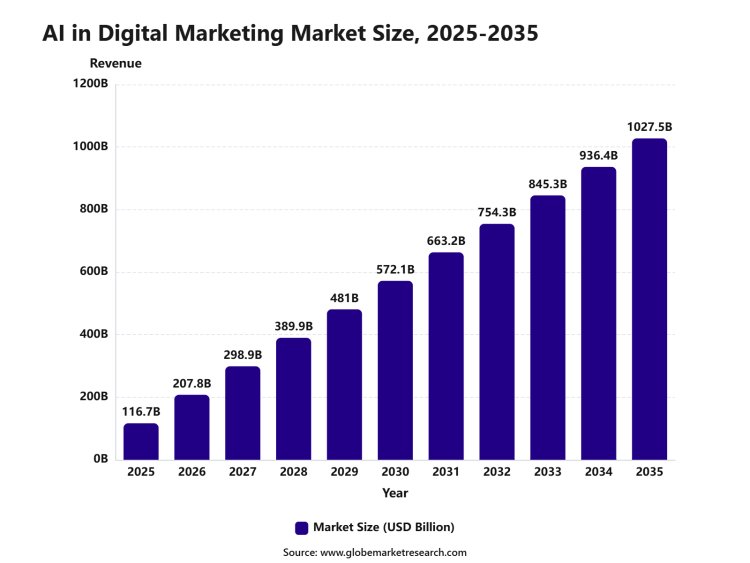
The Global AI in Digital Marketing Market was worth USD 116.7 billion in 2025 and is expected to reach USD 1,027.5 billion by 2035, growing at a CAGR of 24.3% from 2025 to 2035. North America held the largest regional share of 40.1% in 2025, supported by strong adoption of marketing automation, AI-powered advertising, customer data platforms, personalization engines, and advanced analytics across retail, media, BFSI, software, and consumer brands.
 globemarketresearch
Share this Post to earn Money ( Upto ₹100 per 1000 Views )

According to Globe Market Research, the Global AI in Digital Marketing Market was worth USD 116.7 billion in 2025 and is expected to reach USD 1,027.5 billion by 2035, growing at a CAGR of 24.3% from 2025 to 2035. Based on this growth rate, the market is estimated to reach around USD 145.1 billion in 2026. North America held the largest regional share of 40.1% in 2025, supported by strong adoption of marketing automation, AI-powered advertising, customer data platforms, personalization engines, and advanced analytics.
AI in digital marketing includes tools and platforms that use artificial intelligence to improve online advertising, social media marketing, content creation, customer engagement, search marketing, email marketing, analytics, and campaign performance. These tools help marketers understand customer behavior, create personalized campaigns, automate routine tasks, and optimize media spending across digital channels.
The market is closely linked with generative AI, predictive analytics, marketing automation, social media optimization, AI-based SEO, AEO, programmatic advertising, and customer journey personalization. Growth is being supported by rising digital ad spending, wider use of AI by marketing teams, stronger pressure to improve ROI, and the need for faster campaign execution.
Why the AI in Digital Marketing Market Is Growing
The growth of the AI in digital marketing market can be attributed to rising digital advertising spending, growing use of generative AI, higher demand for personalization, and wider adoption of automated campaign tools. IAB reported that U.S. internet advertising revenue reached nearly USD 300 billion in 2025, rising 13.9% year over year, showing the continued strength of digital media spending.
AI adoption is also becoming more common inside marketing teams. Salesforce reported that 63% of marketers are currently using generative AI, while AI is being used for content creation, predictive analytics, campaign planning, personalization, and customer engagement.
Performance improvement is another major driver. Google reported that advertisers using AI Max in Search campaigns typically saw 14% more conversions or conversion value at a similar CPA or ROAS. Campaigns that were mostly using exact and phrase keywords saw an even higher typical uplift of 27%.
Social Media Marketing Leads by Channel
Social media marketing led the channel segment with 65.8% share in 2025. This leadership is supported by rising use of AI for audience targeting, content scheduling, sentiment analysis, ad personalization, social listening, influencer tracking, and campaign performance measurement.
Social platforms are now important for product discovery, brand engagement, short-form video, creator-led campaigns, direct shopping, and customer service. AI helps brands test different creatives, identify audience segments, adjust campaign timing, and improve engagement across platforms such as Instagram, Facebook, TikTok, LinkedIn, YouTube, and X.
This segment is expected to remain strong because brands are shifting from manual social media management to data-led campaign optimization. AI tools can help marketers track audience behavior, compare creative performance, generate captions, monitor sentiment, and improve paid social advertising returns.
Content Marketing Leads by Strategy
Content marketing accounted for 66.3% share by strategy in 2025. This segment is leading because brands are using AI to create, edit, optimize, and personalize content across blogs, websites, emails, product pages, landing pages, ads, and social campaigns.
AI-supported content marketing helps teams improve speed, topic planning, keyword mapping, user intent matching, and performance tracking. This is important because marketers need more content across different channels, languages, buyer stages, and customer segments.
The segment is also gaining strength from AI search and answer engine optimization. Salesforce noted that 88% of marketing teams are already optimizing content for AI-driven search answers rather than only conventional search results. This shows that AI visibility is becoming a direct part of digital content strategy.
Machine Learning Leads by Technology
Machine learning led the technology segment with 63.2% share in 2025. The segment remains central to AI in digital marketing because machine learning supports predictive analytics, audience segmentation, recommendation engines, campaign scoring, automated bidding, and real-time personalization.
Machine learning helps marketers identify patterns in customer behavior. It can analyze browsing data, purchase history, email engagement, ad response, search behavior, and product interest to improve targeting accuracy and reduce wasted media spending.
The technology is also important for campaign automation because it helps systems learn from previous performance. This supports better decisions around budget allocation, customer lifetime value, churn prediction, lead scoring, product recommendations, and dynamic creative optimization.
Retail Leads by End User
Retail led the end user segment with 34.4% share in 2025. Retailers are strong adopters of AI in digital marketing because they need better personalization, product recommendations, customer retention, pricing support, promotional targeting, and campaign automation.
AI is helping retail brands improve digital shopping journeys by matching products with customer needs more accurately. It supports targeted promotions, cart recovery, personalized emails, chatbots, virtual assistants, loyalty campaigns, and product discovery.
Retail adoption is also being supported by the growth of e-commerce and retail media. Brands and retailers are using customer data, purchase signals, search behavior, and campaign analytics to deliver more relevant product offers and improve conversion across online and offline channels.
North America Leads the AI in Digital Marketing Market
North America led the AI in digital marketing market with 40.1% share in 2025. The region benefits from strong digital advertising maturity, high AI adoption among marketers, advanced cloud infrastructure, and a large base of retail, media, technology, e-commerce, BFSI, and consumer goods companies.
The U.S. remains the main regional driver because it has a strong marketing technology ecosystem and high spending across search, social, video, display, commerce media, and creator-led advertising. The region is also home to major AI advertising platforms, CRM providers, cloud companies, and marketing automation vendors.
The regional outlook is supported by continued investment from major digital platforms. Meta reported USD 55.0 billion in advertising revenue in the first quarter of 2026, up 33% year over year, showing continued strength in AI-supported digital advertising and social media monetization.

Go-to-Market Strategy for AI Digital Marketing Providers
A successful go-to-market strategy should focus on measurable marketing outcomes. Providers should position AI tools around lower customer acquisition cost, higher conversion, faster content production, better personalization, improved lead quality, and clearer campaign attribution.
Solution-led selling is the best fit for this market. AI digital marketing platforms should be bundled with customer data integration, creative workflow tools, analytics dashboards, privacy controls, brand governance, testing systems, and campaign automation features.
Vendors should avoid selling AI only as a content-generation tool. The stronger opportunity is in full-funnel marketing support, including audience planning, creative testing, keyword analysis, landing page optimization, campaign monitoring, lead scoring, and customer retention.
Pilot programs should be built around clear KPIs. These may include conversion uplift, cost-per-lead reduction, content production time saved, email open rate improvement, return on ad spend, customer lifetime value, and campaign reporting accuracy.
Revenue Potential and Financial Impact
Revenue potential is spread across AI-powered advertising, social media automation, content marketing tools, predictive analytics, programmatic advertising, CRM intelligence, conversational marketing, personalization engines, retail media, and AI-based SEO and AEO tools.
The strongest revenue opportunity is in campaign automation and performance marketing. Brands are spending heavily on paid media, but they also need better returns, faster testing, and improved budget control. AI tools that directly improve conversion, bidding, targeting, and creative performance are likely to gain stronger adoption.
The financial impact is also linked with productivity. Salesforce reported that marketers deploying AI correctly saw a 20% increase in ROI and a 19% reduction in costs, while high-performing marketers saved an average of eight hours per week through automation.
AI can also reduce waste in marketing operations. It can help teams identify poor-performing campaigns earlier, generate more creative variations, improve customer segmentation, and reduce manual reporting work. This makes AI valuable for both large enterprises and smaller marketing teams.
Risk Factors and Market Barriers
The biggest restraint is data quality. AI marketing systems need clean, connected, and permission-based customer data. If data is fragmented across CRM, email tools, ad platforms, websites, social channels, and offline systems, campaign accuracy may be limited.
Privacy and consent remain major concerns. AI-powered personalization depends on customer data, but regulations and consumer expectations require transparency, consent, secure data handling, and clear limits on automated decision-making.
Brand safety is another barrier. AI can create content quickly, but poor review processes may lead to inaccurate claims, generic messaging, tone mismatch, or off-brand creative. Human review and approval workflows remain important for high-risk industries such as finance, healthcare, insurance, and education.
Attribution is also difficult. Marketers often run campaigns across paid search, social media, email, influencer content, marketplaces, websites, apps, and AI-assisted customer journeys. This makes it harder to measure which tool or channel created the final result.
Key Opportunities in the AI in Digital Marketing Market
The strongest opportunity is in AI campaign automation. Brands need tools that can plan, launch, monitor, test, and optimize campaigns across multiple channels without increasing manual workload.
AI-powered content marketing is another major opportunity. Companies need more articles, emails, landing pages, product descriptions, ad copies, social posts, and short-form video scripts, but they also need stronger brand control and factual accuracy.
E-commerce personalization is also a high-value area. AI can recommend products, personalize offers, predict buying intent, trigger cart recovery messages, and improve loyalty campaigns based on customer behavior.
AI-based SEO and AEO are emerging fast as search behavior changes. Brands are now optimizing for Google AI Overviews, ChatGPT, Perplexity, Gemini, voice search, and answer-based discovery. This creates new demand for structured content, entity optimization, FAQ strategy, and authority-building.
Analyst Perspective: What the Data Is Telling AI in Digital Marketing Companies
The data shows that AI in digital marketing is moving from experimentation to core marketing infrastructure. A market value of USD 116.7 billion in 2025 and a projected value of USD 1,027.5 billion by 2035 indicate strong long-term demand, but buyers will favor tools that improve measurable campaign performance.
The strongest signal is that social media marketing, content marketing, machine learning, retail, and North America are leading demand. Social media marketing held 65.8% share, content marketing held 66.3% share, machine learning held 63.2% share, retail held 34.4% share, and North America held 40.1% share in 2025.
What Opportunities Are Emerging?
The biggest opportunity is in automated campaign optimization. Marketers want AI tools that improve targeting, bidding, testing, personalization, and reporting without creating more operational complexity.
Content and creative automation are also strong opportunities. Brands need faster production, but they also need content that remains accurate, brand-safe, and useful for users.
Retail and e-commerce personalization offer strong commercial potential. Product recommendations, dynamic offers, loyalty campaigns, and customer journey automation can directly improve conversion and retention.
What Risks Should Companies Be Aware Of?
The main risk is poor data readiness. AI tools may underperform if customer data is incomplete, duplicated, outdated, or disconnected across platforms.
Privacy risk is also important. Marketing teams must ensure that AI-based personalization follows consent rules, data protection requirements, and customer trust expectations.
Another risk is content quality. If AI creates generic, inaccurate, or repetitive content, brand authority may decline and search performance may weaken.
What Decisions Should Clients Make Next?
Clients should first identify the highest-value use case. Campaign automation, content optimization, customer segmentation, product recommendation, lead scoring, and AEO are better starting points than broad AI transformation.
Second, companies should assess their data foundation. CRM data, website analytics, email behavior, ad platform data, product feeds, consent records, and customer profiles should be reviewed before scaling AI.
Finally, clients should select AI providers based on integration strength, privacy controls, brand governance, measurable ROI, workflow fit, and support for human review. The best tools should improve marketing decisions without removing strategic oversight.
Recent Developments
In May 2025, Google introduced AI Max for Search campaigns. The feature suite uses Google AI for search term matching, asset optimization, and final URL expansion, with Google reporting a typical 14% uplift in conversions or conversion value at a similar CPA or ROAS.
In March 2025, Adobe expanded its GenStudio content supply chain offering for marketing and creative teams. The update focused on AI-supported campaign content production, brand governance, workflow control, and faster creative delivery.
In April 2026, Adobe highlighted new GenStudio for Performance Marketing capabilities designed to support campaign optimization, content scaling, and performance marketing workflows. The update reflected rising enterprise demand for AI-driven content supply chain systems.
In April 2026, Meta reported first-quarter advertising revenue of USD 55.0 billion, up 33% year over year. The result showed continued strength in AI-supported ad delivery, social advertising, and performance-based digital marketing.
Competitive Landscape
The AI in digital marketing market includes advertising platforms, CRM companies, marketing automation vendors, cloud providers, generative AI companies, social media platforms, analytics providers, and customer engagement software firms. Competition is increasing as enterprises shift from standalone AI tools to integrated marketing systems.
- Google LLC
- Adobe Inc.
- Salesforce Inc.
- IBM Corporation
- Amazon Web Services
- Microsoft Corporation
- Meta Platforms, Inc.
- HubSpot Inc.
- SAP SE
- Klaviyo Inc.
- Braze Inc.
- Twilio Inc.
- Sprout Social Inc.
- Jasper AI
- Other Key Players
Competition is expected to increase around campaign automation, AI content creation, customer data platforms, predictive analytics, social media tools, and AI-based SEO and AEO solutions. Larger companies may benefit from platform scale and data access, while specialist firms may compete through speed, usability, niche marketing functions, and vertical-specific workflows.
The strongest companies will be those that combine AI performance with privacy controls, brand safety, workflow integration, and measurable business results. Buyers will look for tools that improve campaign outcomes while keeping marketers in control of strategy, compliance, and customer experience.
Conclusion
The AI in digital marketing market is entering a strong growth phase as brands shift toward automated campaign management, AI-assisted content creation, predictive analytics, and personalized customer engagement. Growth is being supported by rising digital ad spending, wider generative AI adoption, stronger need for performance measurement, and increasing use of AI in social media and retail marketing.
Future growth will be led by social media marketing, content marketing, machine learning, retail personalization, campaign automation, and AI-based search visibility. Companies that invest in clean data, privacy-first systems, brand governance, and practical AI use cases will be better positioned to scale AI in digital marketing successfully.
Explore More Reports