Why Forged Flanges Are the Preferred Choice for High-Pressure Industrial Applications
Why forged flanges are ideal for high-pressure applications, offering superior strength, durability, leak-proof performance.
 vipulbaibhav
Share this Post to earn Money ( Upto ₹100 per 1000 Views )
A couple of years earlier, I was on the site of a petrochemical company expansion project by a major player in Jamnagar, Gujarat. It was 42°C outside, but it became extremely hot inside the steam distribution unit under very high-pressure conditions. Hydro-testing was carried out on an important pipe circuit that was at 1500 Class rating, and things went normally except that a fine crack along one of the most crucial sections of the piping eventually couldn't sustain the test pressure and burst open, scattering water throughout the workshop area in all directions.
After thorough examination of the situation, it turned out that one of the mistakes made in supply was the replacement of a forging by a casting at a place where only a forging had been ordered. That particular episode made one of those moments when I grasped an important aspect of plant engineering, which is, that, sooner or later, all of the plant engineering managers and heads Indian procurement learn: in the end, it is by the selection of parts you go with that you decide not only if you have a system that's capable of serving you reliably, but also how long it is going to deliver that performance to make your system profitable. Fluid handling system design to withstand the pressure cycles as well as heavy weights is not only for the system functioning, but also for the procurement of the parts is a crucial phase; in fact, it's a thin layer that separates an industrial unit that is very productive & profitable from another that has had its shutdown, in an expensive factory.
For industries where risk is a big factor, like domestic oil companies or those fertiliser plants in Hazard, Forged Flanges would be the most popular choice of pipe connection, which can endure high pressures.
Metallography of the real world: the reason for the survival of parts is decided by the manufacturer
Well, on visual inspection, two flanges of the same steel grade may have shown the same physical properties like size, shape, number of bolt holes, pressure rating according to ASME B16.5, etc. But only when you get them cut open, feel the surfaces' roughness, and test them under acid conditions, you will be able to realize how much they differ.
About Differences Between Casting And Forging Essay
Casting is the operation of melting metal and pouring it into a mold cavity, then letting the material solidify. The structure that results from cooling a metal that was melted is not going to be a pure random array, but the formation will still be governed by a directional preference because different crystals will grow at a time and from the sides.
This technique is also prone to a number of defects such as micro-porosity, gas pockets, and volumetric contractions, which are characteristics of a casting item. Cast iron pipes were commonly used for the fabrication of water pipe systems. A cast part would fail only at low pressures due to leakage, and this could be ignored. But, in the event that the pressure becomes very high, over 2500 PSI, it would mean that the presence of micropores would give rise to initiation and spreading out of the fatigue cracks, eventually causing a failure.
Holding the metal blank in the state that is just suitable for forging (billet) is the first stage. Then, by either a press/hammer, heavy force is applied against the metal from one side over the workpiece plane.
Forging is the technique of heating a blank to forging temperature (billet form) and then forging with heavy force (press or hammer) applied in one direction in the plane.
Such operations will yield parts of desirable shape, and the forging of billets by hydraulic press or hammer is an illustrative example of one of the standard techniques.
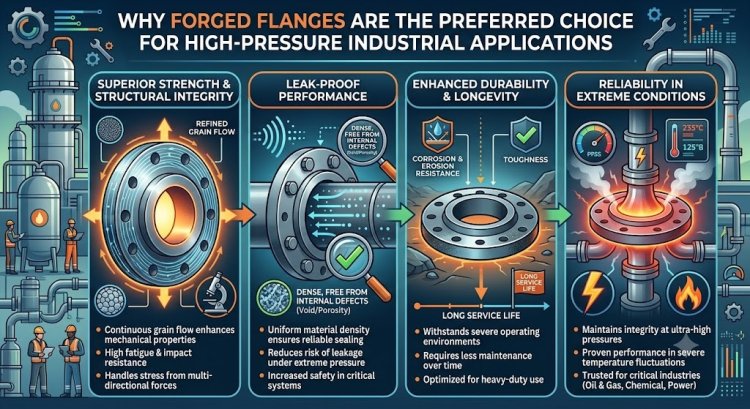
Most Importantly: The forging process not only changes the shape of a piece, but it also changes the orientation of its crystalline structure to a greater extent, making it extremely durable by avoiding all the flaws that may cause failures, and the resultant improvement will make this forging material one of the best choices for such a case as high-stress resistance and toughness that would be very unlikely if they are cast ones.
Looking at quality forged flanges, one can be convinced of the fact that a part is likely to handle very high hoop stress and bending stress without failure.
Main Mechanical Strengths in High Pressure Working Conditions
I do not want to blame the teams if they make the same mistakes as the unit price versus life cycle fatigue Cost comparison is actually a tricky thing, especially since the initial price comparison looks easy.
● Good Resistance to Fatigue and Dampening of vibrations
Pipelines under high pressure do change their condition from time to time. For example, pumps produce variations in pressure, valves closing rapidly will give rise to the water hammer column, and a shift in temperature will create a load of a serious nature.
A continuous grain pattern of the forged steel results in a huge gap in impact toughness between that obtained through a Charpy V-notch test and a cast metal product.
● Getting Rid of Possible Hidden Defects at the Time of Production
If a person decides to use only the machining process to cut down on the amount of metal casting a casting flange, then the presence of subsurface gas pockets or of slag inclusions in metals will likely be found on the face where a gasket is going to be sealed.
Important Note:
Even if there is one little micro-void anywhere at the RF (raised face) or the RTJ (ring-type joint) groove, there is going to be an instant and massive pressure loss (seat pressure). The gas would then easily find a way out (by going through it), and the seal would break apart (in case of the system being pressurized).
e) Extremely High Yield Strength at Extreme Temperatures:
For extremely cold lines, such as those for cryogenic LNG (-196°C) operations or for the case of very hot steam above 500°C, the forged alloys will neither weaken their yield strength nor change their structural ductility. In fact, they may attain their theoretical maximums at those extreme temperatures.
Choosing the right piping components requires one to understand, firstly, what the pressure-temperature ratings of the components are given in ASME B16.5 and B16.47 standards.
Understanding Class Rating and Material Choice
Materials shall be chosen according to the class rating requirement of the component and the expected pressure-temperature service condition it will face in a piping system.
It must be understood that when high-pressure applications are going to be carried out in the Indian Process industry, the use of 'Forged Flanges' that are produced to the specifications of ASTM A105 (Normalized carbon steel for general/boiler applications), and ASTM A182 (Ferritic and Austenitic grades) will cover the safety margins that are required to be followed under the Indian Code/IBR.
Quality of the Product, Quality of the Workmanship and the level of Compliance with Industry Standards by an Indian valve supplier is what will make the difference in the market.
State-owned enterprise industries like IOC, BPCL, NTPC, together with the major Engineering Firms operating within the private and engineering limited companies of India in the industrial sector, adopt extremely elaborate, thorough, and very strict inspection systems and have high quality control measures. The purchase of high-pressure valves is a very closely scrutinized procedure, and the manufacturer's quality control procedures are examined very closely at every stage.
BASIC NON-DESTRUCTIVE TEST (NDT) REQUIREMENTS:
Reliable connectors should be bought, so the Material Test Report (MTR) shouldn't be the main certificate you take from your supplier. Insist as well on the following non-destructive tests for getting the assurance that he is actually selling you the top-grade forging metal:
● Ultrasonic Test (UT) per ASTM A388: To detect any flaws, lamellations, or bursts in the forging ingot, which should have the minimum reduction ratio of 2: 1 for fully refined grain formation
● Magnetic Particle Inspection(MPI) or Dye Penetrant Inspection(DPI): These detect the presence of very small cracks in surfaces that are subjected to stress, which is likely to be the weld neck hub transition area.
● Positive Material Identification(PMI): This method, using XRF spectroscopy, ensures that the alloy is free of contamination with low alloys so the alloy is not confused with the low-grade one.
● Hydrostatic & Pressure Proof Test: It is a verification that the assembly as a whole is capable of safely containing the pressure.
Cost of Purchase: Initial Investment vs Overall Cost of Ownership
A simple matter of fact: a purchase of a forged item is far more expensive (15% to 35%) than that of a casting.
What makes this money worth spending? Let's see!
Think that a single unscheduled breakdown in the operation of a 100, 000-BBL per day oil refinery, the loss of daily revenue due to the products of refined oil, amounts to a level of ₹1.5 to ₹2.5 Crores, much higher than the initial procurement budget for all of a section of the plant.
Forged Flanges with high integrity, on the other hand, have a much lower total cost (labor for gasket-changing, environmental fines for fugitive emissions, and the possibility of a fatal failure of the seal) if the costs of the seal joint are taken into account.
A Strategic Procurement & Engineering Checklist for Indian Teams
Before you place your next Purchase Order (PO) of components, quickly do this self-evaluation:
● Is IBR Form III-C certification the only kind given for the authorization in the case of steam pipeline installation if the project needs it, i.e., IBR Approval?
● Forging Ratio: Is the vendor sure that the reduction in cross-sectional area was at least 3: 1 from billet to final forging in order to obtain fully refined grains?
● Heat Treatment: Are carbon steel parts completely heat treated (A105N) and alloyed parts either solution treated /annealed and quenched and tempered?
● Dimensional Tolerances: Do the size of the hub, the wall thickness, and the pattern of the surface conform only to ASME B16.5/B16.47 specifications?
● Traceability: Is each item of the product clearly imprinted with heat no, grade of material, size, pressure class, and manufacturer's logo so that any product, at any time, in its supply chain can be traced?
You simply ensure that these parameters are met from the very beginning and, therefore, your machinery will be dependable throughout the years and not have any failures.