What Are the Best Fintech API Integration Solutions to Accelerate Business Growth?
Discover the best fintech API integration solutions that help businesses streamline financial services, improve customer experiences, automate operations, and accelerate scalable business growth.
 nimble-appgenie
Share this Post to earn Money ( Upto ₹100 per 1000 Views )
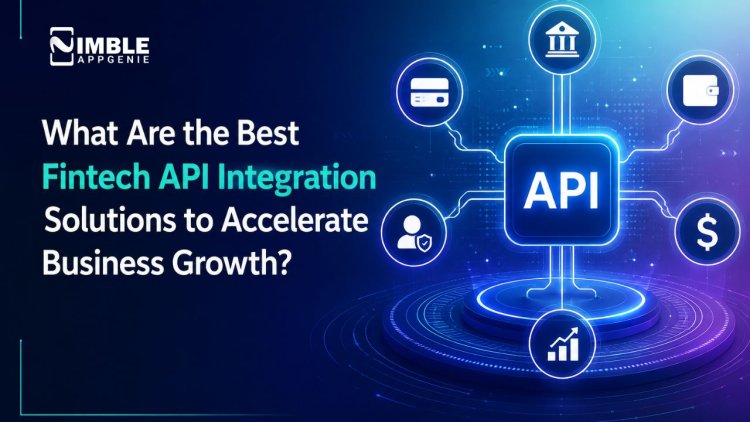
Modern financial businesses run on connectivity. Payments, banking data, and compliance checks all depend on systems talking to each other in real time. Choosing the right fintech api integration approach directly impacts how fast a company scales, how secure its transactions are, and how satisfied its customers stay.
This guide breaks down the top solutions available today and how they drive measurable business growth.
What Is Fintech API Integration and Why Does It Matter?
Fintech api integration is the process of connecting financial software, apps, or platforms with external services banks, payment processors, credit bureaus, or accounting tools using application programming interfaces (APIs).
Instead of building every function from scratch, businesses plug into existing, tested infrastructure, which is where Nimble AppGenie's api integrations for fintech come in.
This matters because:
- Customers expect instant payments, real-time balances, and one-click onboarding
- Regulatory requirements demand accurate, auditable data exchange
- Competitors who integrate faster launch new features faster
Without solid fintech integrations, businesses end up with fragmented systems, manual workarounds, and slower time-to-market, all of which quietly erode growth.
What Are the Best Fintech API Integration Solutions Available Today?
Not all integrations serve the same purpose. Here are the categories businesses rely on most.
1. Open Banking APIs
Open banking APIs let apps securely access customer bank account data (with consent) for account verification, balance checks, and transaction history. They're foundational for lending platforms, budgeting apps, and neobanks.
2. Payment Gateway APIs
These connect a platform to payment processors like Stripe, Plaid, or Dwolla, enabling card payments, ACH transfers, and digital wallets. A reliable payment API is often the single most important piece of any fintech api platform.
3. KYC and AML Verification APIs
Identity verification and anti-money-laundering checks are non-negotiable in finance. APIs from providers like Jumio or Trulioo automate this, cutting onboarding time from days to minutes.
4. Core Banking APIs
For businesses building banking-as-a-service products, core banking APIs handle account creation, ledger management, and transaction processing behind the scenes.
5. Data Aggregation APIs
These pull financial data from multiple sources into a single dashboard, useful for wealth management platforms and financial planning tools.
Each of these represents a distinct fintech integration solution, and most modern platforms combine several to deliver a complete product experience.
How Do You Choose the Right Fintech API Platform for Your Business?
Selecting a finance api integration platform isn't just about features - it's about fit. Consider:
- Security and compliance certifications (SOC 2, PCI DSS, GDPR where applicable)
- Scalability - can the API handle growth from thousands to millions of transactions?
- Documentation and developer support - poor docs slow down every future update
- Pricing structure - per-transaction fees can add up fast at scale
- Uptime and reliability track record
Working with experienced api integrations for fintech specialists helps businesses avoid costly missteps, especially when compliance requirements vary by state and transaction type across the USA.
What Are the Benefits of Partnering with Fintech API Companies?
Building integrations in-house is possible, but most businesses gain more by partnering with specialized fintech api companies. The advantages include:
- Faster deployment - pre-built connectors and proven frameworks shorten development cycles
- Lower risk - experienced teams understand compliance pitfalls before they happen
- Ongoing support - APIs evolve, and partners handle updates and maintenance
- Custom architecture - solutions built around specific business models, not generic templates
This is exactly where fintech api integration services add value: they turn a complex technical challenge into a manageable, well-supported project.
How Does a Strong Fintech Integration Solution Accelerate Business Growth?
The connection between integration quality and growth is direct. A well-built fintech integration solution:
- Reduces customer drop-off during onboarding by simplifying verification
- Enables faster feature rollouts, keeping pace with market demand
- Builds trust through consistent uptime and secure data handling
- Frees internal teams to focus on product innovation instead of maintenance
Businesses that treat API integration as a growth lever not just a technical task, consistently outperform those that treat it as an afterthought.
Conclusion
Choosing the right fintech api integration solution shapes how quickly and securely a business can grow. From payment gateways to compliance APIs, the right combination reduces friction and builds customer trust.
Nimble AppGenie helps businesses across the USA design and implement integration strategies built for long-term, sustainable growth.
Frequently Asked Questions
1. What is the difference between a fintech API and a fintech API platform?
Answer: A fintech API is a single connection point for one function, like payments or identity verification. A fintech api platform bundles multiple APIs into one unified system, simplifying management.
2. How long does fintech API integration typically take?
Answer: Timelines vary by complexity, but most projects take four to twelve weeks, depending on the number of integrations and compliance requirements involved.
3. Are fintech API integrations secure for handling financial data?
Answer: Yes, when built to standards like PCI DSS and SOC 2, with encryption, tokenization, and strict access controls in place throughout the data flow.
4. Which businesses benefit most from fintech api integration services?
Answer: Neobanks, lending platforms, payment apps, wealth management tools, and any business processing financial transactions or verifying customer identity benefit significantly.
5. How much does fintech API integration cost?
Answer: Costs depend on the number of APIs, transaction volume, and customization needs, ranging from a few thousand dollars for simple integrations to six figures for enterprise-grade systems.