Thermal Showdown: Heat Pipes vs Vapor Chamber GPU — Spreading Resistance and Max Heat Flux
When comparing heat pipes to a vapor chamber GPU, the key differences lie in spreading resistance and maximum heat flux. Heat pipes are effective for moving heat along a linear path, making them reliable for compact cooling designs.
 industrialmanufacturer
 Share this Post to earn Money ( Upto ₹100 per 1000 Views )

In modern graphics cards, the cooling solution is as performance‑critical as the silicon itself. As GPUs push into higher power envelopes and denser die layouts, the way heat is collected, spread, and ultimately rejected to airflow determines not only boost clocks and acoustic comfort, but also long‑term reliability. Consequently, thermal engineers and performance enthusiasts alike keep circling the same pivotal question: when should you choose a classic multi‑pipe cooler, and when does a vapor chamber GPU architecture pull ahead?
At Tone Cooling Technology Co., Ltd., we spend a lot of time on precisely this problem. Both heat pipes and vapor chambers rely on the same underlying physics—phase change and capillary pumping—but they move and spread heat in fundamentally different ways. Because of that, their limits and advantages show up differently in two key metrics that matter for GPUs:
- Spreading resistance: the extra temperature rise caused by distributing heat from a concentrated source (the GPU die) into a wider base before it enters the fin stack.
- Maximum heat flux: the peak heat per unit area a wick/working‑fluid system can transport without dry‑out or runaway temperature rise.
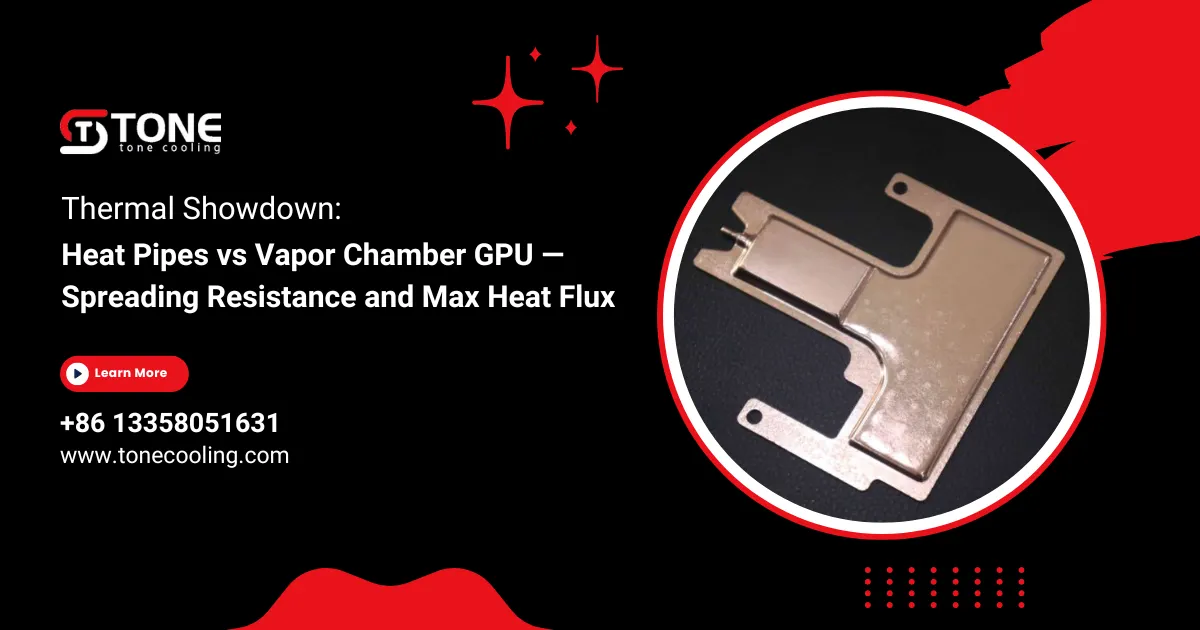
While these terms can feel abstract at first, they directly translate into practical outcomes like junction temperature, fan speed curves, noise, throttling behavior, and lifespan. Furthermore, as card layouts evolve—larger dies, chiplets, expanded VRAM footprints, denser VRM islands—the thermal load is not just higher; it’s also more spatially complex. Therefore, the geometry of the heat transport device (1D tubes versus a 2D plate) increasingly matters.
Why this showdown matters right now
Historically, a well‑executed array of heat pipes soldered into a copper baseplate was the workhorse solution for GPUs up to ~250–300 W. The baseplate spread heat laterally; heat pipes whisked it to fin stacks; multiple fans handled airside convection. However, once you push toward 300–500 W board power—and especially when the die heat is highly concentrated—two bottlenecks become visible:
- Baseplate spreading resistance: A thick copper base conducts well, but it still adds temperature rise when heat must travel laterally from a small hotspot into a larger fin interface.
- Heat pipe “coverage”: Heat pipes are superb at 1D transport along their centerline, yet there can be gaps between tubes and uneven thermal pickup if the die footprint or VRAM layout doesn’t align perfectly with pipe locations.
By contrast, a vapor chamber GPU replaces the thick baseplate and discrete tubes with a single, sealed, two‑phase plate. Consequently, the evaporator region sits right under the die, and the vapor spreads heat laterally inside the chamber before condensing beneath a broad fin area. This architecture attacks spreading resistance head‑on, and, when done well, it tends to equalize temperatures across the fin base more effectively than a pipe‑and‑plate stack.
Heat pipes vs vapor chambers: the shared physics—and the crucial differences
Both devices use a working fluid (often water for the temperature range of GPUs) and a capillary wick structure to circulate liquid to the hot zone. Heat input causes local boiling/evaporation; vapor travels to a cooler region, condenses, and releases latent heat; the wick then returns the liquid to the evaporator. Nevertheless, there are two key distinctions:
- Heat pipes are linear. Their best performance is along the pipe axis. They are excellent for transporting heat over distances to a remote fin stack. Yet they don’t inherently “spread” heat laterally; the baseplate must do that via solid conduction, which introduces spreading resistance.
- Vapor chambers are planar. They spread heat in two dimensions inside the vapor space. As a result, they can achieve much lower in‑plane temperature gradients across the base under high, localized fluxes—precisely the scenario of a modern GPU core.
- Practically, that means a vapor chamber GPU often reduces the temperature delta between the die center and the fin base, enabling more uniform fin utilization and smoother fan curves. Meanwhile, heat pipes can still be outstanding when the heat source is elongated or when design constraints favor routing multiple pipes to fins arranged around the card’s perimeter.
Spreading resistance, explained without the jargon
Imagine your GPU dies as a bright, intense “spotlight” of heat. Before that heat can be shed to the airflow, it must expand into a much larger area that interfaces with the fin stack. Any time heat must travel laterally through a finite‑thickness solid (like a copper base), there is a penalty—extra temperature rise—called spreading resistance. Thicker baseplates and higher‑k materials reduce it but at the cost of mass and, sometimes, space. Moreover, there are diminishing returns: doubling base thickness helps, yet it rarely eliminates gradients under very high heat flux.
A vapor chamber GPU sidesteps part of this limitation. Because the evaporating vapor can move laterally with very small temperature gradients, the chamber effectively acts like a super “in‑plane conductor,” redistributing heat under the fins. As a result, the fin array sees a broader, more uniform heat footprint. In many designs, this improves overall cooling efficiency, particularly under transient loads and hotspot‑heavy workloads.
Maximum heat flux: where phase‑change limits show
The other side of the showdown is maximum heat flux (q″max). Every wick and working fluid combination has limits governed by several mechanisms:
- Capillary limit: The wick can only generate so much pumping pressure to return liquid to the evaporator. If evaporation outpaces return, the hot spot dries out.
- Boiling limit: Excessive nucleation and vapor generation can destabilize liquid supply to the wick interface.
- Sonic and entrainment limits: At high vapor velocities, flow chokes or entrains liquid droplets, reducing effective return flow.
Heat pipes and vapor chambers use similar wicks (e.g., sintered powder, mesh, grooves, or hybrid designs), so their intrinsic heat flux ceilings can be comparable. However, geometry changes how those limits are reached. A vapor chamber GPU concentrates the evaporator right under the die and then provides a wide “escape” area for vapor, which can mitigate local congestion and reduce the path length for lateral spreading. In short, the chamber’s 2D space often tolerates higher localized flux without dry‑out compared to a pipe array that relies on the baseplate to distribute heat to multiple discrete pipe inlets.

That said, wick design is decisive. A robust sintered wick with appropriate pore size distribution and thickness can support very high fluxes—often well above the typical 20–60 W/cm² seen on large GPU dies—provided the chamber height, vapor space, and condenser area are proportioned correctly. Conversely, a less optimized wick or insufficient condenser capacity can bottleneck even a vapor chamber GPU.
At Tone Cooling Technology Co., Ltd., our engineering approach weighs all of these factors holistically. We prototype both vapor chamber GPU and heat‑pipe assemblies, then tune wick structures, plate thickness, fin pitch, and fan profiles to the actual use case—gaming bursts, sustained rendering, or compute workloads. In many scenarios, vapor chambers unlock headroom that translates to quieter acoustics at the same junction or lower temperatures at the same noise level. In others, a thoughtful heat pipe design reaches the target with less material cost or mass. Consequently, the “best” solution is the one that aligns thermal performance with product constraints.
FAQ
What is a vapor chamber gpu, in plain terms?
A vapor chamber gpu uses a sealed, flat, two‑phase heat spreader directly under the GPU. Heat causes liquid inside to evaporate; vapor spreads laterally within the chamber and condenses under the fin base, releasing heat. The wick returns liquid to the hot zone. This reduces in‑plane temperature gradients and lowers spreading resistance compared with a thick copper baseplate.
Are heat pipes obsolete now that vapor chambers are common?
No. Heat pipes are extremely effective, mature, and cost‑efficient. They shine when heat must be moved to a remote fin bank, when the source area is elongated, or when budgets and mass limits are tight. Vapor chambers complement them by excelling at planar heat spreading under high, localized flux.
How big is the real‑world difference in spreading resistance?
It depends on die size, flux, base thickness, and material. Under high flux and a relatively small die, a vapor chamber gpu can reduce center‑to‑edge temperature deltas at the fin base by several degrees Celsius compared to a copper baseplate. This often translates to lower junction temperatures or reduced fan speeds for the same target.
What determines maximum heat flux limits?
Wick type and geometry, pore size, working fluid, chamber height, and condenser capacity. The capillary limit—the ability to pump liquid back to the evaporator—often dominates. A well‑designed vapor chamber gpu with a sintered wick typically supports GPU‑die‑level fluxes comfortably, but design and validation are essential.
Does orientation matter (horizontal vs. vertical GPUs)?
While modern wicks aim for orientation‑agnostic performance, gravity still influences return flow. High‑quality chambers and pipes mitigate this, but verifying in your intended orientation is smart. Some designs show a small temperature rise in unfavorable orientations; others remain nearly unchanged.
Will a vapor chamber gpu always be quieter?
Often, but not always. Better spreading can reduce hotspot‑driven fan ramps, enabling smoother acoustics. However, overall noise depends on fin density, fan selection, control algorithms, and case airflow. In a constrained chassis, both designs might need higher fan speeds to maintain targets.
What about VRAM and VRM cooling?
Both approaches can cool adjacent components through shared base structures, contact pads, and heat plates. Vapor chambers frequently offer more uniform base temperatures across a large footprint, which can help with VRAM/VRM. Conversely, heat pipe layouts can be tuned with direct pads or additional mini‑pipes to target these zones.