SVF Therapy for Hip AVN and Knee Osteoarthritis: Why It Is Becoming an Integral Part of Regenerative Orthopedic Care in India

Share this Post to earn Money ( Upto ₹100 per 1000 Views )

Quick Answer

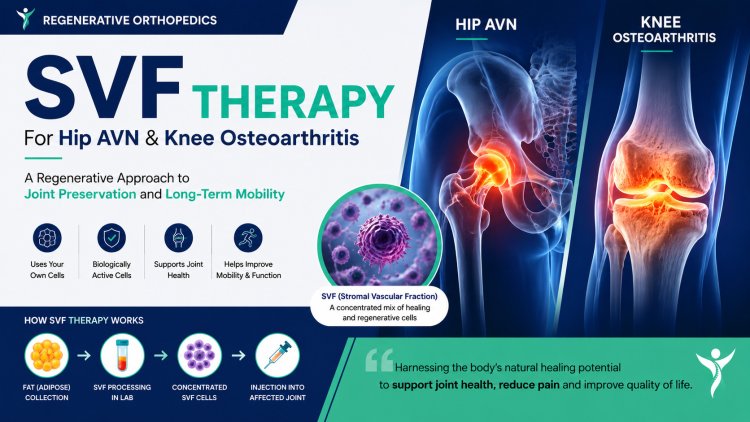
SVF (Stromal Vascular Fraction) therapy is emerging as a well-recognized regenerative treatment approach for selected patients with Hip Avascular Necrosis (AVN) and Knee Osteoarthritis in India. By utilizing regenerative cells obtained from a patient's own adipose (fat) tissue, SVF therapy is increasingly being incorporated into modern orthopedic care with an emphasis on joint preservation, improved mobility, and personalized treatment planning.


Modern Orthopedics Is Moving Beyond Conventional Treatment

Orthopedic medicine has undergone significant changes over the past decade.

Earlier, treatment strategies largely focused on pain management, physiotherapy, medications, and surgery when the condition progressed.

Today, specialists are adopting a broader approach that combines conventional orthopedic care with regenerative medicine whenever appropriate. The goal is not only to reduce symptoms but also to preserve joint function, maintain mobility, and improve long-term outcomes for carefully selected patients.

This evolution has made SVF therapy an increasingly important part of orthopedic discussions across India.


What Is SVF Therapy?

SVF, or Stromal Vascular Fraction, is a regenerative cellular fraction isolated from a patient's own adipose tissue.

Researchers have identified adipose tissue as a rich source of biologically active cells that participate in cellular communication, vascular support, and tissue maintenance.

The stromal vascular fraction may contain:

  • Mesenchymal stromal cells
  • Endothelial progenitor cells
  • Pericytes
  • Fibroblasts
  • Immune-regulating cells
  • Vascular support cells

Because the treatment utilizes the patient's own tissue, SVF therapy is considered an autologous regenerative procedure and has become an important area of interest in regenerative orthopedics.


Why Is SVF Therapy Becoming More Widely Accepted?

The growing acceptance of SVF therapy reflects continuous progress in orthopedic science.

Several factors have contributed to this trend, including:

  • Better understanding of regenerative medicine
  • Earlier diagnosis of orthopedic conditions through advanced imaging
  • Increased clinical experience among orthopedic specialists
  • Greater patient awareness of regenerative treatment options
  • Continued scientific research on cellular therapies

Together, these developments have strengthened confidence in regenerative approaches such as SVF therapy.


Why Is SVF Therapy Important for Hip AVN?

Hip AVN develops when blood supply to the femoral head becomes compromised.

As circulation decreases, bone tissue may gradually weaken, affecting the structure and function of the hip joint.

Patients often experience:

  • Persistent hip pain
  • Groin pain
  • Hip stiffness
  • Difficulty walking
  • Reduced mobility

Early diagnosis plays a major role in treatment planning.

When AVN is identified before advanced collapse, orthopedic specialists may evaluate various joint-preserving treatment strategies. For selected patients, SVF therapy has become one of the regenerative options considered within an individualized treatment plan.


Why Is SVF Therapy Being Explored for Knee Osteoarthritis?

Knee Osteoarthritis affects the entire joint rather than cartilage alone.

Modern research has demonstrated that changes occur in:

  • Articular cartilage
  • Bone
  • Synovial membrane
  • Ligaments
  • Joint capsule
  • Overall joint biology

This broader understanding has encouraged specialists to investigate regenerative treatments that support the biological environment of the knee.

As a result, SVF therapy has become an increasingly discussed regenerative option for selected patients with Knee Osteoarthritis.


Personalized Medicine Is Driving Better Outcomes

One of the defining characteristics of modern orthopedic care is personalization.

Instead of recommending identical treatment pathways for every patient, orthopedic specialists evaluate:

  • Disease stage
  • MRI findings
  • Severity of symptoms
  • Activity level
  • Functional goals
  • Overall health condition

This individualized approach allows physicians to determine whether regenerative therapies such as SVF are appropriate for a patient's specific clinical situation.


Why More Patients Trust SVF Therapy

Patient confidence in SVF therapy has grown steadily because of increasing awareness and education.

Individuals diagnosed with Hip AVN or Knee Osteoarthritis frequently research regenerative medicine before consulting a specialist. They want to understand available treatment options and learn whether joint-preserving approaches may be suitable for their condition.

At the same time, orthopedic specialists continue to refine patient selection, treatment protocols, and follow-up strategies based on evolving clinical experience and scientific evidence.

This combination of informed patients and experienced physicians has helped strengthen trust in regenerative orthopedic care.


The Role of Evidence-Based Orthopedic Care

Every treatment recommendation should be supported by careful clinical evaluation and scientific understanding.

Orthopedic specialists consider multiple factors before recommending regenerative therapies, including:

  • Clinical examination
  • MRI assessment
  • Disease progression
  • Functional limitations
  • Patient expectations

This evidence-based approach helps ensure that treatment decisions are appropriate, individualized, and aligned with current orthopedic practice.


The Future of SVF Therapy in India

Interest in regenerative medicine continues to expand throughout India.

As more orthopedic centers adopt evidence-informed regenerative treatment protocols and scientific research continues to grow, SVF therapy is expected to play an increasingly important role in comprehensive orthopedic care.

Its combination of autologous regenerative cells, personalized treatment planning, and joint preservation principles reflects the future direction of modern musculoskeletal medicine.


Conclusion

SVF therapy has become an increasingly established regenerative treatment approach for selected patients with Hip AVN and Knee Osteoarthritis in India. Advances in regenerative medicine, improved clinical expertise, personalized treatment planning, and growing patient awareness have all contributed to its expanding role within orthopedic care.

As orthopedic medicine continues to evolve, SVF therapy represents a modern regenerative option that supports the goals of joint preservation, improved mobility, and individualized patient care. For patients exploring treatment options, consultation with a qualified orthopedic specialist remains the most important step in determining the most appropriate management strategy.

TL;DR

SVF therapy uses regenerative cells obtained from a patient's own adipose tissue and is increasingly becoming part of modern orthopedic care in India for selected patients with Hip AVN and Knee Osteoarthritis. Growing clinical experience, regenerative medicine research, and personalized treatment planning continue to strengthen its role in joint preservation strategies.