
Land Acquisition Risk Assessment in India: How to Identify and Mitigate Project Risks Before Investment
A step-by-step guide to spotting title, encumbrance, and regulatory risks in Indian land deals before you commit capital.
 Kishan Kumar
Share this Post to earn Money ( Upto ₹100 per 1000 Views )
Key takeaways
● Most land acquisition disputes in India trace back to title and revenue record issues that existed before the buyer's involvement, not to anything that goes wrong during the transaction itself.
● A clean sale deed does not confirm a clean title. Title risk, encumbrance risk, litigation risk, and regulatory risk are separate categories, and a due diligence process that checks only one of them leaves the others unexamined.
● Revenue records in India are maintained at the state level, in formats and terminology that differ from state to state, which is why a due diligence process built around one state's land records does not transfer cleanly to a project in another state.
● Land acquired for industrial use carries regulatory risk beyond title, including zoning and land-use conversion, environmental clearance thresholds, and, where applicable, rehabilitation and resettlement obligations under the LARR Act, 2013.
● Encumbrance certificates cover registered charges only. Unregistered agreements, pending succession claims, and pledged shares in jointly held family land can all sit outside what an encumbrance certificate shows.
● The cost of catching a title or regulatory defect before investment is a due diligence fee. The cost of catching it after possession or construction has begun is a stalled project, and the gap between the two is the entire argument for doing this work upfront.
Introduction
Land disputes in India rarely announce themselves during the transaction. A sale deed gets signed, registration goes through, and possession changes hands without incident. The risk usually surfaces later, sometimes years later, when a legal heir contests the sale, a pending court case surfaces in a records check the buyer never ran, or a state authority flags the land use as non-compliant with the zoning it was purchased under.
For an industrial project, the cost of that timing is significant. A title dispute that surfaces after a plant is under construction does not just threaten the land, it threatens the capital already committed to building on it. Land acquisition risk assessment done properly happens before the investment is made, not after a problem forces the issue.
Why land acquisition carries structural risk in India
Land records in India are maintained at the state level, through revenue departments that use different formats, terminology, and digitization levels across states. A due diligence checklist built around one state's land record system does not transfer cleanly to a project in another state, which is one reason a generic, one-size-fits-all approach to land risk assessment tends to miss things.
On top of that structural variation, several categories of risk are specific to how land ownership and land use are governed in India.
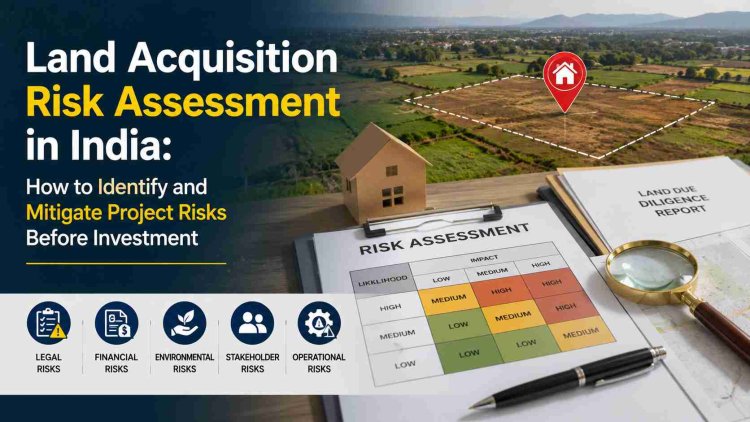
● Title risk: Ownership can be contested through unresolved succession claims, undivided family holdings, or a chain of title that was never properly recorded through every transfer.
● Encumbrance risk: A parcel can carry mortgages, liens, or pending charges that are not obvious from a sale deed alone.
● Litigation risk: Civil suits over boundary disputes, partition claims, or possession are common and can remain pending for years without appearing in a routine records check.
● Regulatory and land-use risk: Land zoned for agricultural use requires formal conversion before industrial use is permitted, and that conversion is not automatic just because a sale has gone through.
● Environmental and clearance risk: Depending on project size and location, environmental clearance, forest land diversion approval, or coastal regulation zone compliance may apply before construction can begin.
● Social and resettlement risk: Where the LARR Act, 2013 applies, rehabilitation and resettlement obligations toward displaced landholders and dependents can carry both cost and timeline implications that are easy to underestimate.
The land acquisition risk assessment process
A structured risk assessment moves through several stages, and each stage is designed to catch a different category of risk. Skipping a stage does not remove that risk, it just moves the point at which it gets discovered from before the investment to after it.

● Title verification: The chain of title is traced back, typically 30 years, through successive transfers to confirm the seller actually holds a clear, transferable right to the land.
● Encumbrance check: An encumbrance certificate is obtained to identify registered mortgages, liens, and charges against the property, with the understanding that this covers registered charges only.
● Revenue record verification: Current ownership and mutation entries are checked against state revenue records, since a sale deed and the underlying revenue record do not always match, particularly where mutation has not been updated.
● Litigation search: Civil court records and, where relevant, revenue tribunal records are checked for pending disputes tied to the property, its boundaries, or its ownership.
● Regulatory compliance check: Zoning classification, any required land-use conversion, and environmental or coastal clearance requirements are confirmed against the intended industrial use.
● Due diligence report: Findings across all of the above are consolidated into a single report that flags specific risks, rather than a general clearance statement, so the buyer can weigh each flag on its own merits before proceeding.
Common gaps in land due diligence
Several specific gaps come up repeatedly in land transactions that later run into trouble, and most of them are avoidable with the right process.
● Relying on an encumbrance certificate alone, which does not capture unregistered agreements, informal family settlements, or pledged shares in jointly held land.
● Treating a registered sale deed as proof of clear title, when the deed only records the transaction itself, not the validity of the seller's underlying ownership.
● Skipping a physical site survey and boundary demarcation, which can surface encroachments or mismatches between the recorded area and the actual plot.
● Underestimating the timeline for land-use conversion or environmental clearance, and assuming these run in parallel with construction rather than needing to be secured beforehand.
● Not accounting for rehabilitation and resettlement obligations early, where the LARR Act, 2013 applies, since these carry both a cost component and a timeline that can extend well beyond the land transaction itself.
Watch the Expert Guide on Legal Due Diligence in India and Identify the Hidden Risks: https://youtu.be/vIUHGE-qY5A?si=HuonYjrpqYUcI_Wk
Mitigating land acquisition risk before investment
● Commission title verification and an encumbrance check as separate, independent steps, rather than treating one as a substitute for the other.
● Engage legal counsel with specific familiarity in the state where the land sits, given how much revenue record systems and land laws vary state to state.
● Confirm zoning classification and any required land-use conversion before finalizing the transaction, not after possession has already changed hands.
● Run a litigation search across both civil courts and relevant revenue tribunals, since a dispute can be pending in either forum depending on its nature.
● Build a realistic timeline for regulatory clearances into the investment plan, rather than assuming these will clear in parallel with construction.
● Where the LARR Act, 2013 applies, assess rehabilitation and resettlement obligations as part of the initial risk assessment, not as a downstream cost discovered later.
Why this work is often outsourced
Land risk assessment sits at the intersection of legal due diligence, revenue record verification, and regulatory compliance, three areas that rarely sit inside the same in-house team for a manufacturer whose core expertise is production, not land law. Verifying a chain of title across a state-specific revenue record system, or confirming which environmental clearance threshold applies to a given project size and location, generally needs specialists who work with these records routinely, not occasionally.
This is the specific gap IMARC Engineering's Land Acquisition and Legal Due Diligence service is built to cover, combining title and encumbrance verification with regulatory and zoning checks before a manufacturer commits capital to a site.
Identify Land Risks Before They Become Costly: https://www.imarcengineering.com/contact?service=land-acquisition-legal-due-diligence
Final thoughts
Land acquisition risk in India is rarely a single point of failure. It is a set of separate risks, title, encumbrance, litigation, and regulatory, that each need to be checked on their own terms rather than assumed clear because the transaction itself went smoothly.
The manufacturers who avoid costly land disputes are generally not the ones who moved fastest to close a deal. They are the ones who treated title, revenue records, and regulatory compliance as three separate questions, each answered before the investment was made rather than after.
Frequently Asked Questions
What is land acquisition risk assessment?
It is the process of verifying title, encumbrances, pending litigation, and regulatory compliance on a parcel of land before finalizing its purchase, so that ownership and use risks are identified before capital is committed rather than after.
How far back should a title search go in India?
A common benchmark is 30 years, tracing the chain of ownership through successive transfers to confirm the seller holds a clear, transferable right to the land.
Does an encumbrance certificate confirm clear title?
No. It confirms the absence of registered mortgages, liens, and charges, but does not capture unregistered agreements, informal family settlements, or pending succession disputes.
What regulatory risks apply to industrial land in India?
Common ones include zoning classification and required land-use conversion, environmental clearance thresholds tied to project size, and, where applicable, coastal regulation zone compliance and rehabilitation and resettlement obligations under the LARR Act, 2013.
Why do land due diligence requirements vary by state?
Revenue records in India are maintained at the state level, using different formats, terminology, and digitization levels, so a due diligence process built for one state's records does not transfer directly to another state.
When should land risk assessment happen relative to investment?
Before the investment is finalized. Catching a title or regulatory defect before purchase costs a due diligence fee. Catching the same defect after possession or construction has begun risks the capital already committed to the project.