Confirmation Statement FAQs: Answers Every UK Company Director Should Know
For many company directors, the Confirmation Statement is one of the most misunderstood filing requirements set by Companies House. Questions about filing deadlines, company eligibility, and legal obligations are common, especially for new business owners. Understanding the basics can help directors remain compliant and avoid unnecessary problems.
 Sid
Sid
Share this Post to earn Money ( Upto ₹100 per 1000 Views )
For many company directors, the Confirmation Statement is one of the most misunderstood filing requirements set by Companies House. Questions about filing deadlines, company eligibility, and legal obligations are common, especially for new business owners. Understanding the basics can help directors remain compliant and avoid unnecessary problems.
Get your Confirmation Statement filing for Companies House today!
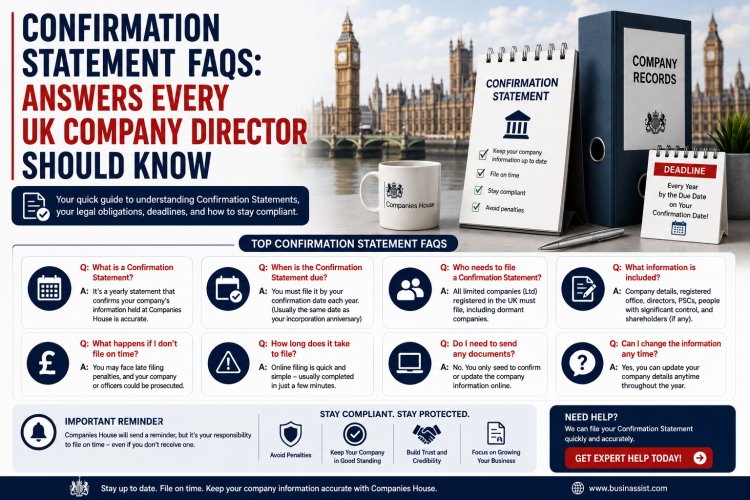
One of the most frequently asked questions is what a Confirmation Statement actually is. A Confirmation Statement is an annual filing submitted to Companies House to confirm that company information held on the public register is accurate. It replaced the Annual Return in 2016 and is required even if there have been no changes during the year.
Another common question is who needs to file one. In most cases, every UK limited company, including dormant companies, must submit a Confirmation Statement at least once every twelve months. Newly incorporated companies also become subject to this requirement after their first confirmation period.
Many directors also ask what information is included in the filing. A Confirmation Statement typically confirms details relating to the company's registered office address, directors, shareholders, Persons with Significant Control (PSC), share capital, and business activities. If changes have occurred, they should generally be updated before or during the filing process.
A common misconception is that filing Annual Accounts removes the need to submit a Confirmation Statement. In reality, these are two separate statutory obligations. Annual Accounts report financial information, while the Confirmation Statement confirms company details. Most companies must complete both each year.
Another important question concerns the consequences of failing to file. Companies that miss their filing deadlines may receive reminder notices from Companies House, followed by enforcement action if the filing remains outstanding. Continued non-compliance could result in company strike-off proceedings or legal action against company officers.
Directors often ask whether professional assistance is necessary. While many companies successfully complete the filing themselves, businesses with complex ownership structures, multiple shareholders, or recent corporate changes often benefit from professional support. Filing services can review company information, identify required updates, and ensure submissions are completed accurately.
Finally, directors frequently ask why the Confirmation Statement is so important. Beyond meeting legal requirements, it helps maintain an accurate public register that supports transparency, protects stakeholders, and strengthens confidence in UK businesses.
Understanding these frequently asked questions helps company directors meet their responsibilities with confidence. By filing the Confirmation Statement on time each year and keeping company records up to date, businesses can remain compliant with Companies House while avoiding unnecessary administrative or legal difficulties.