Advanced Rhinoplasty Surgery in Delhi: Natural Nose Reshaping Guide
Discover clinical insights on advanced rhinoplasty surgery in Delhi by top plastic surgeon Dr. Lokesh Handa. Learn about procedures, healing timelines, and structural nose job costs at Med Esthetiks.
 medesthetiks
Share this Post to earn Money ( Upto ₹100 per 1000 Views )
The nose sits at the literal and visual center of the face, heavily dictating overall facial harmony. For many individuals, an out-of-proportion nose—whether due to a genetic dorsal hump, droopy tip, wide nostrils, or trauma—leads to persistent self-consciousness. Beyond aesthetics, structural nasal issues frequently cause chronic breathing difficulties, sleep apnea, and sinus complications. For those seeking a permanent structural and visual resolution, undergoing Rhinoplasty surgery in Delhi at a state-of-the-art facility offers a reliable path to achieving symmetry and unimpeded respiratory airflow.
Modern aesthetic surgery prioritizes personalized facial preservation and structural support over cookie-cutter changes. By choosing an experienced, board-certified cosmetic plastic surgeon in Delhi, patients can secure natural-looking outcomes tailored to their unique ethnic traits and facial proportions. This clinical guide explores the core techniques, recovery pathways, and cost factors associated with the procedure.
The Architecture of Facial Harmony: Why Structure Matters
The human nose is a complex three-dimensional structure of bone, cartilage, and soft tissue draped under a delicate envelope of skin. Experienced surgeons plan modifications by analyzing the nose in relation to the forehead, cheeks, lips, and chin.
Key facial proportions, such as the nasolabial and nasofaced angles, must be preserved to prevent an unbalanced look. When planning treatment with the best cosmetic surgeon in Delhi, patients undergo a thorough facial analysis to ensure the newly sculpted nose looks inherently native to their face. Crucially, removing too much support structure can cause delayed nasal valve collapse. Modern rhinoplasty, therefore, focuses on rearranging and reinforcing the existing nasal framework rather than aggressive tissue reduction.
Cosmetic and Functional Indications for Nasal Reconstruction
Many patients consult a plastic surgery doctor in Delhi to smooth out a prominent bridge hump made of bone and cartilage. By performing a controlled osteotomy and shaving down the excess cartilage, the bridge is restored to a straight, elegant contour. Similarly, a bulbous, drooping, or asymmetrical nasal tip can be refined using suturing techniques and cartilage grafts to establish a defined, stable, and natural tip definition.
Correcting a Deviated Septum and Restoring Natural Airflow
Functional rhinoplasty, often combined with a septoplasty, corrects internal structural blockages. A deviated septum restricts airflow, causing chronic mouth breathing, dry mouth, snoring, and sinus infections. During a functional procedure, the best plastic surgeon in Delhi straightens the septal cartilage, reduces hypertrophied turbinates, and reconstructs the internal nasal valves to permanently restore smooth, effortless breathing.
An Overview of Modern Rhinoplasty Techniques
For complex structural changes, the open technique remains the gold standard. A tiny, transcolumellar incision is made across the strip of skin separating the nostrils, allowing the surgeon to lift the nasal skin envelope for complete visualization of the underlying anatomy. This ensures highly precise grafting, suturing, and structural modifications. The resulting scar is minimal, placed strategically in the natural shadows of the nasal base, and typically fades to a virtually invisible line.
The Closed Rhinoplasty Approach
In contrast, closed rhinoplasty involves making all incisions entirely inside the nostrils, completely eliminating the risk of external visible scarring while ensuring a slightly faster recovery. However, this approach limits direct visualization, making it most suitable for patients requiring minor refinements, such as mild bridge reduction. Choosing the optimal technique requires a detailed evaluation by an expert top plastic surgeon in Delhi.
Revision and Reconstructive Rhinoplasty
If a patient is dissatisfied with a primary procedure performed elsewhere, revision rhinoplasty can address the structural or aesthetic issues. Revision surgeries are highly complex, navigating existing scar tissue and compromised cartilage support. These cases often require harvesting cartilage from the patient's ear or rib to rebuild the collapsed structural walls of the nose.
Step-by-Step: The Rhinoplasty Surgery Procedure in Delhi
The modern rhinoplasty surgery procedure in Delhi follows a highly standardized, safety-first clinical protocol:
Phase 1: Pre-Surgical Analysis and Digital Mapping
During the initial consultation at the best cosmetic clinic in Delhi, high-resolution photographs are taken from multiple angles. The surgeon utilizes digital imaging tools to discuss potential outcomes, evaluating skin thickness, skeletal strength, and airway latency.
Phase 2: Anesthesia Administration
The procedure is performed under general anesthesia or deep intravenous sedation, continuously monitored by a dedicated, board-certified anesthesiologist to ensure maximum patient safety.
Phase 3: Making the Strategic Incisions
Incisions are executed based on the chosen open or closed approach. The skin is gently elevated to access the underlying bony and cartilaginous framework.
Phase 4: Structural Reshaping and Grafting
The surgeon carefully reshapes the bone using specialized micro-osteotomes or advanced ultrasonic tools (piezoelectric rhinoplasty). Cartilage harvested from the septum, ear, or rib is carved and sutured into place as structural support grafts to reinforce the nasal airway and stabilize the new shape.
Phase 5: Incision Closure and Splinting
The nasal skin is redraped, and incisions are closed with fine sutures. Silastic splints are inserted internally to support the septum, and a rigid external splint is applied to protect the nose bridge and minimize early swelling.
Navigating Your Recovery: What to Expect Post-Surgery
The recovery process after a nose job is highly predictable when patients follow postoperative clinical instructions:
-
Days 1 to 3: Peak period for swelling, mild bruising, and stuffiness. Keep your head elevated and use cold compresses around the eyes.
-
Week 1: The patient returns to the plastic surgery clinic in Delhi to have the external splint and any non-dissolvable sutures safely removed.
-
Weeks 2 to 4: Major swelling and bruising subside rapidly. Most patients feel entirely comfortable returning to work and light activities, while avoiding strenuous physical exertion.
-
Months 2 to 6: Residual swelling resolves, particularly at the nasal tip, revealing a more defined and refined contour.
-
One Year: Complete healing and tissue maturation are fully realized, leaving the internal tissues strong, stable, and healthy.
Understanding Rhinoplasty Surgery Cost in Delhi
The total rhinoplasty surgery cost in Delhi is not a fixed, flat rate; rather, it depends heavily on several clinical variables.
First, the complexity of the case plays a major role, as revision surgeries require more operative time and grafting resources than straightforward cosmetic reductions. Second, the facility’s infrastructure, safety standards, and specialized equipment affect costs. Third, the surgeon's experience, anesthesia fees, and the use of advanced tools (like ultrasonic piezoelectric systems) also influence the investment.
When researching the general plastic surgery cost in Delhi, patients must prioritize surgical safety and clinical expertise over cut-rate pricing to prevent the need for corrective revision surgeries. A transparent breakdown of the estimated Rhinoplasty cost in Delhi will be provided during your individual consultation.
Establishing Clinical Trust: The Med Esthetiks Philosophy
Choosing to undergo facial surgery is a deeply personal and significant decision. At Med Esthetiks, clinical excellence, patient safety, and absolute medical integrity form the cornerstone of every single treatment plan.
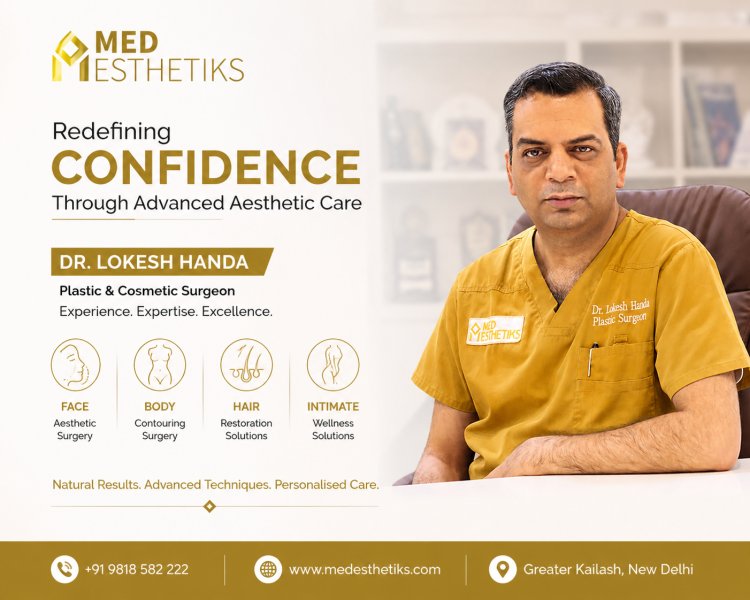
As a highly respected, board-certified Rhinoplasty surgeon in Delhi, Dr. Lokesh Handa brings over 18 years of specialized plastic surgery experience. Holding advanced qualifications of M.S. and M.Ch., Dr. Handa is recognized as a premier Nose job doctor in Delhi who blends a meticulous eye for artistic proportion with rigorous microsurgical techniques.
Operating within a cutting-edge clinical environment in Greater Kailash, South Delhi, Med Esthetiks adheres to the most stringent global medical safety protocols, sterilization standards, and comprehensive, empathetic follow-up care to ensure a seamless, reassuring, and highly successful patient journey.
Frequently Asked Questions (FAQs)
Will rhinoplasty surgery completely alter my entire facial appearance?
Rhinoplasty is designed to enhance your natural features, not replace them or make you look like a different person. The ultimate goal of a highly skilled surgeon is to bring your nose into harmonious balance with your forehead, eyes, lips, and chin. By adjusting the proportions of your nose to match the rest of your face, your overall facial appearance will look more balanced, attractive, and balanced. People may notice that you look more refreshed or symmetrical, but the results should look so natural that the surgical intervention remains completely imperceptible to others.
How long does the swelling last after undergoing a nasal reshaping procedure? The resolution of postoperative swelling is a gradual, multi-phase physiological process. Approximately seventy to eighty percent of the visible, external swelling and any bruising around the eyes will subside within the first two to three weeks following surgery, allowing you to comfortably return to your normal social and professional activities. The remaining twenty percent of subtle, localized swelling—primarily concentrated at the nasal tip—resolves slowly over the subsequent six to twelve months. It is during this late stage of healing that the final, highly defined contours of your new nose will fully emerge and stabilize.
Can a nose job procedure resolve my long-term snoring and breathing issues?
Yes, rhinoplasty can be highly effective at resolving functional respiratory issues when performed as a structural, functional procedure. If your snoring, sleep apnea, or breathing difficulties are caused by anatomical obstructions—such as a severely deviated nasal septum, internal nasal valve collapse, or enlarged turbinates—a combined rhinoplasty and septoplasty can permanently correct these blockages. By straightening the internal septal framework and reconstructing the nasal valves, your surgeon will optimize the nasal airways, allowing for smooth, unrestricted, and effortless breathing through your nose.
Will I have visible, permanent scars after my rhinoplasty surgery?
The presence and visibility of scarring depend entirely on the specific surgical approach utilized for your procedure. In a closed rhinoplasty, all surgical incisions are made completely inside the nostrils, resulting in absolutely no external or visible scarring. In an open rhinoplasty, a tiny incision is made across the columella, which is the narrow strip of tissue between your nostrils. This incision is closed using ultra-fine sutures and placed carefully within the natural contour shadows of the nasal base, causing it to fade into a virtually invisible micro-line over time.
At what age can a young adult safely undergo rhinoplasty?
Rhinoplasty should only be performed once an individual's facial skeleton and nasal bones have achieved complete physical maturity. For females, this developmental milestone is typically reached around the age of fifteen or sixteen, while for males, physical growth is usually complete by the age of seventeen or eighteen. Performing the surgery before the nasal structures have finished growing can disrupt future facial development and compromise the long-term aesthetic and functional results. It is also essential that the patient exhibits the emotional maturity necessary to understand the procedure and maintain realistic expectations.
How long must I wait to wear prescription eyeglasses or sunglasses after surgery?
To protect the newly reshaped nasal bones and cartilage during the crucial early healing phase, you must avoid resting any weight on the bridge of your nose for approximately four to six weeks following your surgery. Wearing heavy glasses directly on the healing bridge can cause structural shifts or indentations in the soft tissues. If you must wear corrective lenses, you can tape them securely to your forehead or utilize specialized off-the-nose glasses supports. Alternatively, you may transition to using soft contact lenses immediately after the first postoperative week.
What measures are taken to ensure my nose looks natural and fits my ethnicity?
Achieving a natural, ethnically harmonious result requires a deep understanding of diverse facial anatomy and customized surgical planning. An experienced surgeon avoids using a single, idealized template for every patient. Instead, they carefully analyze your unique ethnic traits, skin thickness, and individual facial proportions. By preserving characteristic ethnic nuances while refining specific structural concerns—such as smoothing a bridge or narrowing a wide nasal base—the surgeon ensures that your new nose looks balanced, elegant, and completely native to your face.
Is it possible to undergo a revision procedure if I am unhappy with a past nose job?
Yes, revision rhinoplasty can be performed to correct aesthetic or functional complications resulting from a primary nose job done elsewhere. However, revision surgeries are exceptionally complex due to the presence of dense scar tissue and the depletion of natural supporting cartilage. These intricate procedures require specialized expertise, advanced reconstructive techniques, and often the harvesting of donor cartilage from the ear or rib. It is highly recommended to wait at least one full year after your primary surgery to allow the tissues to heal completely before undergoing a revision evaluation.
Choosing to undergo nose reshaping is a transformative milestone that represents a significant investment in both your physical health and personal self-confidence. By addressing both aesthetic imbalances and chronic functional obstructions, this highly customized surgical procedure can profoundly improve your daily quality of life, allowing you to breathe with ease and present yourself to the world with renewed poise.
To achieve a result that is both safe and visually stunning, your journey must begin with an educational, transparent, and highly personalized consultation with a trusted, board-certified expert. Under the guidance of an experienced clinical specialist who prioritizes natural-looking outcomes and patient safety, you can confidently explore the ideal techniques tailored to your unique anatomy. Contact Med Esthetiks today to schedule your comprehensive evaluation, discuss your aesthetic goals, and embark on a personalized path toward structural harmony and lasting confidence.
Clinic Contact Details
-
Clinic Name: Med Esthetiks
-
Director & Chief Surgeon: Dr. Lokesh Handa (M.S., M.Ch.)
-
Location: Greater Kailash-1, New Delhi, Delhi, India
-
Phone / Consultation Booking: +91 8800203431
-
Official Website: https://www.medesthetiks.com